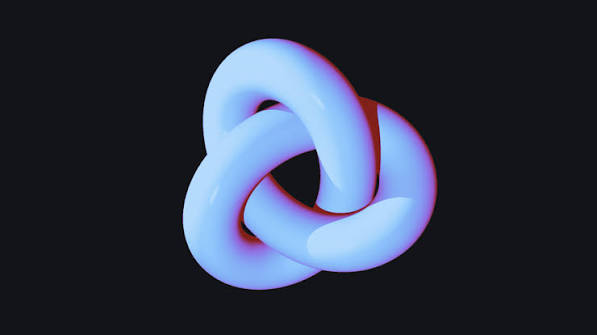

Topology entered physics through an idea that initially seems almost too abstract to influence an experiment. Geometry distinguishes objects by distances, angles, curvature, and precise shape. Topology deliberately ignores most of that information. A sphere can be stretched, flattened, and distorted without ceasing to be topologically equivalent to itself. A torus cannot be transformed into a sphere by any smooth deformation because the hole through the torus would have to disappear. Somewhere during that transformation, the object would have to be cut, pinched shut, or otherwise pass through a singular configuration.
The familiar comparison between a coffee mug and a doughnut captures this distinction, but it also hides what makes topology powerful in quantum physics. Physicists are rarely interested in whether an actual crystal resembles a torus. The important objects are often much more abstract: quantum wave functions, momentum spaces, families of energy eigenstates, order-parameter fields, or trajectories traced by quasiparticles. These structures can possess global properties that cannot be changed by small local modifications. Quantum mechanics makes those global properties observable.
A material can be deformed. Its atoms can be imperfectly positioned. Disorder can alter local potentials. Individual energy levels can shift. Yet certain global properties of its quantum states may remain unchanged unless the system undergoes a qualitative transition in which an energy gap closes or a protecting symmetry is destroyed. When that happens, topology ceases to be merely a way of classifying mathematical shapes. It becomes a principle that constrains what a physical system is allowed to do.
This is the central idea behind topological quantum matter: local microscopic details may vary continuously while a global quantum structure remains discrete.
The first conceptual step is recognizing that quantum mechanics contains its own kind of geometry. A quantum state is not simply a collection of measurable numbers; it is represented by a vector in a complex state space, and multiplying that vector by an overall phase does not alter the physical state. If external parameters are slowly varied, the state can move through this space and eventually return to its original physical configuration while acquiring an additional phase that depends on the path it has taken. Michael Berry showed in 1984 that this additional contribution is geometric. The Berry phase does not depend only on how long the system evolves, but also on the route traced by the quantum state through parameter space.
This introduces a striking departure from ordinary classical intuition. A system can return to the same local physical state while retaining information about the global path through which it arrived there. In crystalline solids, the relevant parameter is often crystal momentum. Because the lattice repeats periodically, momenta separated by reciprocal-lattice vectors describe equivalent physics, and the resulting space of momenta, called the Brillouin zone, acquires a nontrivial global structure. In two dimensions, opposite edges of the Brillouin zone are identified, so topologically the momentum space behaves like a torus.
At every point on this momentum-space torus lies a quantum eigenstate associated with an electronic band. Moving through momentum space changes that eigenstate continuously. Instead of studying only how the energy of an electron changes, one can therefore study how the quantum state itself twists while it is transported around the Brillouin zone. The local twisting is described by Berry curvature, while the total twisting across the full momentum space can produce an integer called a Chern number. This integer is one of the clearest points at which an abstract topological property becomes experimentally measurable physics.
The decisive physical example appeared in the quantum Hall effect. When electrons are confined to two dimensions and placed in a strong perpendicular magnetic field, their transverse electrical conductance forms extraordinarily precise plateaus rather than varying smoothly. In 1982, David Thouless, Mahito Kohmoto, Peter Nightingale, and Marcel den Nijs showed that the integer governing this quantization could be identified with a topological invariant of the occupied electronic states. The result, now associated with the TKNN invariant, established a direct correspondence between the Chern number of the quantum bands and a measurable electrical response.
This was a profound shift in the language of condensed-matter physics because many material properties are strongly sensitive to microscopic details. Conductivity normally depends on scattering rates, impurities, carrier densities, atomic structure, temperature, and interactions. In the quantum Hall regime, however, the Hall response is pinned to an integer determined by the global structure of the electronic wave functions. The precision is not accidental. An integer cannot drift smoothly from one value to another. A Chern number of one cannot gradually become 0.93 because a few atoms are displaced or because weak disorder is introduced. As long as the assumptions defining the phase remain valid and the bulk energy gap stays open, smooth perturbations can deform the quantum states without changing their topological class.
This is the deeper meaning of topological protection. Protection does not imply that nothing microscopic changes. Energy dispersions can deform, wave functions can rearrange, local densities can fluctuate, and the material can be imperfect. What remains fixed is the global invariant. The situation is analogous to continuously reshaping a torus without closing its hole: almost every geometric detail can change, but the topological class remains intact.
This viewpoint also explains why a topological phase transition is fundamentally different from an ordinary small change in a material. Suppose the Hamiltonian of a crystal is altered continuously by pressure, chemical composition, magnetic order, strain, or another control parameter. As long as the occupied and unoccupied bands remain separated by an energy gap, their wave functions can generally deform continuously as well, and their topology cannot simply jump. For the topological invariant to change, the mathematical structure defining it must become singular somewhere. In a band system, that usually means the bulk energy gap closes. At the transition, occupied and unoccupied states meet, and the distinction that allowed the invariant to be defined temporarily fails. Once the gap reopens, the system may emerge with a different topological index.
F. Duncan M. Haldane made this logic especially striking in 1988 by constructing a model on a honeycomb lattice that exhibited a quantized Hall response even though the net magnetic flux through the unit cell vanished. The topology was therefore not fundamentally tied to the conventional Landau-level mechanism of the quantum Hall effect. Instead, it could arise from the internal structure of a lattice Hamiltonian itself. The Haldane model helped establish a much broader principle: quantum bands can possess topology independently of the literal shape of the material or the presence of a large external magnetic field. That realization opened the way toward topological insulators, Chern insulators, Weyl semimetals, topological superconductors, and a much broader classification of quantum matter.
One of the most remarkable consequences of this global structure is that topology in the interior of a material can force physical states to appear at its boundary. Consider two insulating systems whose bulk electronic structures belong to different topological classes. Deep inside either material, the electrons may be separated from conducting states by an energy gap. If the two systems are joined together, however, the topological invariant must change somewhere between them. Because that invariant cannot change smoothly while the gap remains open, the gapped description has to fail at the interface, and the failure appears as a boundary state.
This is the essence of bulk-boundary correspondence. The topology of the bulk determines the existence of lower-dimensional excitations at an edge or surface. In the integer quantum Hall system, a two-dimensional gapped bulk supports conducting one-dimensional edge channels. Yasuhiro Hatsugai showed explicitly how the bulk Chern number and the winding structure of the edge states are related. [4] The boundary is therefore responding to information stored globally throughout the bulk. No individual atom near the edge needs to contain the Chern number. The boundary state exists because a topological phase cannot terminate against a topologically different environment without reconciling the mismatch.
The vacuum itself can be treated as a topologically trivial phase. A topological material placed next to vacuum is therefore an interface between two distinct quantum structures, and the conducting surface becomes the physical manifestation of their incompatibility. This is one of the clearest examples in modern physics of an abstract mathematical invariant forcing a directly observable state to exist.
Topological insulators generalize this principle beyond the ordinary quantum Hall setting. In a conventional insulator, completely filled electronic bands are separated from empty bands by an energy gap, preventing low-energy electrical conduction through the bulk. A topological insulator can also possess a gapped interior, but the organization of its occupied quantum states differs globally from that of an ordinary insulator.
Time-reversal symmetry changes the classification. A Chern number describing net Hall transport vanishes when time-reversal symmetry is preserved, yet Charles Kane and Eugene Mele showed in 2005 that another discrete topological distinction survives. Their work introduced the Z₂ topological invariant into the description of the quantum spin Hall state. [5] The result again appears at the boundary. A two-dimensional quantum spin Hall insulator supports counterpropagating edge modes related by time-reversal symmetry, while a three-dimensional topological insulator supports metallic surface states surrounding an insulating interior.
Experiments soon observed these structures in real materials. Angle-resolved photoemission measurements on bismuth-antimony alloys directly mapped topological surface states, and subsequent work identified materials such as Bi₂Se₃ with a single surface Dirac cone. [6][7] These experiments transformed topology from an elegant classification scheme into a directly visible feature of the electronic spectrum of real crystals.
The phrase “protected surface state” requires care, because topological protection is not equivalent to absolute invulnerability. A time-reversal-invariant topological insulator owes part of its protection to time-reversal symmetry. Perturbations that preserve that symmetry cannot simply remove the characteristic surface structure without changing the topology or closing the relevant gap, but magnetic order can break time-reversal symmetry and alter the protection. Strong disorder, interactions, finite temperature, coupling to uncontrolled degrees of freedom, and additional trivial surface bands can also complicate the idealized picture.
Topology therefore protects classes of behavior under specified deformations. It does not make a physical system immune to every form of disturbance. This distinction becomes increasingly important when topology is discussed in the context of technology. A topological qubit, edge channel, or surface state may be substantially less sensitive to certain local perturbations than a non-topological counterpart, but every real implementation remains subject to physical processes that lie outside the protected class.
Topology becomes even stranger in Weyl semimetals, because the relevant topological objects are no longer fully gapped phases. A Weyl semimetal contains isolated points in three-dimensional momentum space where two electronic bands touch. Near such a point, the quasiparticles satisfy a low-energy equation analogous to the Weyl equation of relativistic quantum field theory. The band touching, however, is not merely an accidental crossing. A Weyl point behaves as a topological source or sink of Berry curvature, so that in momentum space the curvature flows outward from one chirality of Weyl node and inward toward the opposite chirality. Mathematically, the nodes behave like monopoles of the Berry field.
These monopoles are not literal magnetic objects sitting somewhere inside the crystal. They exist in momentum space, yet they generate observable consequences in real space. Theoretical work by Xiangang Wan, Ari Turner, Ashvin Vishwanath, and Sergey Savrasov predicted that Weyl semimetals should support unusual open surface states called Fermi arcs. Unlike the closed Fermi surfaces familiar from ordinary metals, these surface states terminate at the surface projections of bulk Weyl nodes carrying opposite topological charge. In 2015, experiments on tantalum arsenide identified Weyl-semimetal behavior and observed the associated surface Fermi arcs using photoemission spectroscopy.
The abstract-to-physical connection is particularly striking here. A monopole-like structure defined entirely in the momentum-space geometry of electronic wave functions determines the existence of an open electronic arc measured on the physical surface of a crystal. Some of the most consequential “shapes” in quantum matter therefore do not exist in ordinary space at all.
The discussion so far concerns the topology of electronic bands, but strongly interacting quantum matter supports an even deeper form of topology that cannot be reduced to the behavior of independent particles. In systems such as fractional quantum Hall states, the many-body quantum state can possess topological order. This differs fundamentally from ordinary symmetry breaking. A ferromagnet can be characterized locally by magnetization, and a crystal can be characterized by broken translation symmetry. A topologically ordered state instead encodes information in global patterns of long-range quantum entanglement and can support quasiparticles whose properties depend on topology itself.
Among these excitations are anyons. Their existence becomes possible because exchanging identical particles behaves differently in two spatial dimensions than in three. In three dimensions, particle exchanges lead to the familiar bosonic and fermionic possibilities. In two dimensions, however, the trajectories taken while particles wind around one another cannot always be continuously untangled. The topology of the path therefore becomes physically meaningful.
For Abelian anyons, exchanging particles can produce a phase that is neither the bosonic nor fermionic value. Arovas, Schrieffer, and Wilczek demonstrated the connection between fractional statistics and quasiparticles in the fractional quantum Hall effect in 1984. For non-Abelian anyons, the structure is richer because exchanging particles transforms the system within a multidimensional quantum-state space, and different sequences of exchanges need not commute. The final state can depend on the topology and ordering of the braid formed by the quasiparticle trajectories. In this setting, the history of particle motion is encoded in the global braid structure of their worldlines.
This structure forms the basis of topological quantum computation. Alexei Kitaev recognized that quantum information could, in principle, be encoded nonlocally in systems containing anyonic excitations and manipulated by moving those excitations around one another. Logical operations would then depend on the braid class of their trajectories rather than on every microscopic detail of how the path was executed.
If one anyon moves around another along a slightly imperfect trajectory, the path may wobble because of weak local disturbances. Geometrically, the trajectory has changed, but topologically it may remain the same braid. If the computation depends only on the braid class, these small geometric distortions do not alter the intended logical operation. This is topology used not merely to explain matter, but to encode and manipulate information.
The idea has motivated decades of work on non-Abelian quantum phases, Majorana modes, fractional quantum Hall platforms, spin liquids, quantum-double models, and synthetic anyonic systems. Quantum processors have now been used to implement non-Abelian braiding behavior and Fibonacci-anyon models in controlled digital settings. These experiments are important demonstrations of the underlying algebraic structure, although digitally simulating an anyonic model remains distinct from constructing a naturally occurring topological medium whose quasiparticles themselves provide passive hardware protection. The strongest vision of topological quantum computation would use the structure of the physical phase, not merely a circuit emulating it, to protect quantum information.
Across these examples, a common principle emerges. Topology discards precise distances, local distortions, and smooth microscopic changes while retaining global information that cannot be removed continuously. Quantum mechanics supplies physical objects for which that global information matters: wave-function phases, bundles of eigenstates, entanglement patterns, quasiparticle trajectories, and many-body state spaces. The combination creates physical quantities that can be almost invisible locally yet unavoidable globally.
Berry curvature can vary continuously from point to point while its total integral remains fixed to an integer. A topological insulator can appear completely gapped in its bulk while its boundary is forced to conduct. A Weyl node can exist as a singularity in momentum space while producing Fermi arcs on a real surface. An anyon's trajectory can be deformed repeatedly while preserving the braid that determines a quantum operation. This is why topology has become such a powerful language for modern quantum physics: it identifies physical information that survives after enormous amounts of microscopic detail have been discarded.
There is an even deeper way to understand the connection. Much of traditional physics begins locally. Newton's laws describe forces acting on objects at particular positions. Electromagnetism describes fields defined at points in space and time. Quantum field theory is built from local operators and interactions constrained by locality and causality. Topology introduces a complementary kind of structure because its defining information is inherently global.
Knowing the microscopic Hamiltonian in one tiny region is not enough to determine a Chern number; one must understand how the quantum state behaves across an entire closed parameter space. Examining a short segment of an anyon trajectory cannot reveal its braid class; the defining information belongs to the complete configuration. Yet these global structures constrain local measurements. The bulk evolves through local physics, but the edge reflects the topology of the entire bulk. A quasiparticle moves locally, but the system can retain information about how its worldline wound around another quasiparticle. A wave function changes smoothly at each momentum, but the collective twisting across momentum space determines an integer that fixes a measurable electrical conductance.
Topology is therefore not an additional force acting on quantum matter. It is a restriction on the space of physically allowed possibilities. It determines which states can be connected smoothly, which boundaries must contain gapless modes, and which particle trajectories belong to genuinely distinct classes.
This perspective also clarifies what physicists mean by a topological phase of matter. Traditional phase classification relied heavily on symmetry and local order parameters. Water freezes because translation and rotational symmetries change when molecules arrange into a crystal. A ferromagnet develops a preferred magnetic direction, and a superfluid develops a coherent order parameter. The Landau framework successfully explains a vast range of phase transitions by identifying which symmetry is broken and which local quantity acquires order.
Topology revealed that this framework is not complete. Two quantum states can possess the same conventional symmetries and still remain fundamentally distinct because their global quantum structures differ. They cannot be transformed into one another smoothly while preserving the relevant energy gap and protecting conditions. Topology therefore adds an additional axis along which matter can be classified.
Modern condensed-matter physics has extended this idea into an enormous landscape that includes Chern phases, symmetry-protected topological phases, intrinsically topologically ordered phases, topological superconductors, crystalline topological phases, higher-order topological phases, Weyl and Dirac semimetals, Floquet topology, and interacting topological states. The mathematical details differ substantially from one class to another, but the physical principle remains remarkably consistent: a quantum phase is determined not only by what its microscopic constituents are, but also by how the complete quantum state is organized.
The word “shape” in topology therefore needs to be interpreted carefully. In some systems, topology genuinely describes spatial configurations. Vortices, defects, knots, skyrmions, and winding textures in physical fields can possess topological charges because their configurations cannot be smoothly unwound. In many of the most important quantum examples, however, the relevant shape belongs to a space we cannot directly see. It may be the shape of a mapping from momentum space into quantum-state space, the global twisting of a family of eigenvectors, the connectivity of a many-body wave function, or the braid formed by histories in spacetime.
What makes quantum topology extraordinary is that these abstract structures control laboratory observables. A number defined over a momentum-space torus becomes an electrical conductance. A global distinction between bulk wave functions becomes a metallic surface. A singularity in Berry curvature becomes a Fermi arc. A braid in spacetime becomes a quantum operation. Topology therefore ties the invisible organization of a quantum state to the measurable behavior of matter.
The deepest significance of topology in quantum physics is not simply robustness. It is the discovery that physics can depend on information that is fundamentally global. A material may contain trillions of atoms, each subject to complicated local interactions, yet some of its most precise physical properties can be determined by an integer that survives smooth microscopic rearrangements. An edge can remain conducting because the wave functions throughout an entire bulk belong to a different topological class than the vacuum outside it. Quasiparticles can retain information about the order in which they were exchanged because their trajectories cannot be continuously untangled.
Topology allows nature to store physical information in relationships rather than in isolated locations. That principle now connects subjects that once appeared largely separate, including the quantum Hall effect, band theory, superconductivity, quantum field theory, Weyl fermions, anyons, spin liquids, quantum error correction, and quantum computation. The unifying insight is that quantum mechanics gives physical meaning to spaces far more abstract than the three dimensions surrounding us. Once quantum states are allowed to twist, wind, braid, and wrap through those spaces, topology determines which transformations remain possible and which are forbidden. In that sense, topology does not merely provide mathematics for describing quantum matter. The global shape of the quantum state becomes part of the physics itself.