A Quantum Field Theory Made From 19 Atoms
A programmable chain of neutral atoms has made the excitation spectrum of conformal field theory directly measurable, turning a mathematical framework used across critical phenomena, statistical mechanics, condensed matter, and high-energy theory into something physicists can probe with spectroscopy.
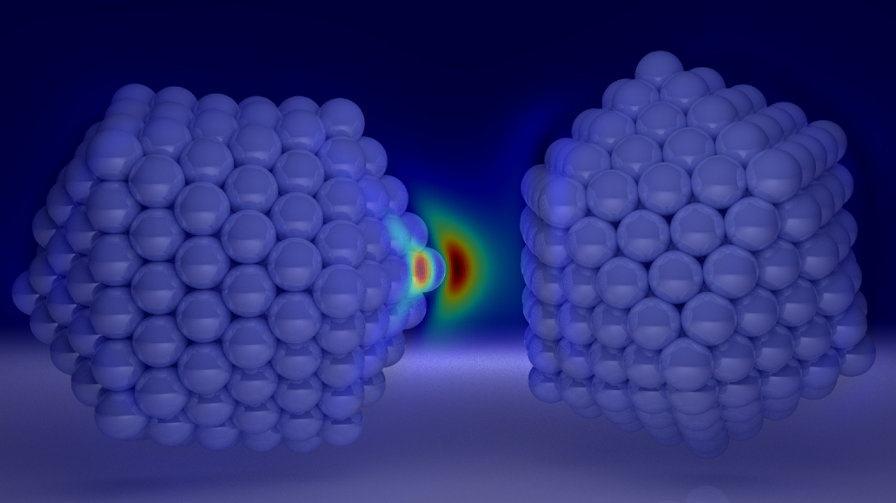
A row of nineteen atoms does not look much like a quantum field theory. Each atom occupies a well-defined position inside an optical tweezer, lasers control whether it remains in a low-energy state or is excited into a strongly interacting Rydberg state, and the entire apparatus fits comfortably inside an ordinary laboratory. Conformal field theory, by contrast, is usually introduced as a continuum framework describing infinitely many degrees of freedom distributed through space and time. Its mathematical language involves scaling dimensions, primary operators, conformal towers, correlation functions, boundary conditions, and symmetries that seem far removed from a small array of individually controlled atoms.
In August 2026, a collaboration led by researchers at Caltech reported in Nature that these two descriptions can meet experimentally. The team tuned programmable chains of strontium atoms to quantum critical points described by the Ising conformal field theory and the more complicated tricritical Ising conformal field theory, then measured the low-energy excitations of those systems directly. For a nineteen-atom chain at Ising criticality, the observed resonance frequencies reproduced the characteristic universal ratios predicted by CFT. By changing how the atoms were driven, the researchers separated symmetry sectors of the spectrum, changed the effective boundary condition at the ends of the chain, and measured a dynamical response governed by an underlying conformal field correlation. [1][2]
The result is important for a reason deeper than the agreement of a few measured frequencies with theory. Near certain quantum phase transitions, microscopic details cease to determine the long-distance behavior of the system. A chain of interacting Rydberg atoms can then be described by the same continuum theory as completely different microscopic models. The atoms remain atoms, but their low-energy collective behavior reorganizes into a field theory whose structure is determined primarily by symmetry, dimensionality, and the character of the critical point. This phenomenon is called universality, and conformal field theory is one of its most powerful mathematical descriptions. [1][3]
The experiment therefore provides a particularly clean demonstration of emergence. The researchers did not program every predicted CFT excitation into the atoms one by one. They engineered a microscopic Hamiltonian, tuned it to the appropriate critical point, and the universal field-theory spectrum emerged from the many-body system. Once the system reached that regime, the relative spacings of its low-energy states were no longer arbitrary properties of the laser setup. They became fingerprints of the conformal field theory governing the transition.
The starting point is a quantum phase transition. In a conventional thermal transition, temperature can drive matter from one phase to another, as when a magnet loses its ordered magnetization. A quantum phase transition occurs at essentially zero temperature when some parameter in the Hamiltonian is varied instead. In the Rydberg experiment, the important controls include the laser detuning, the Rabi frequency governing transitions between atomic states, and the interactions between atoms excited into Rydberg states.
Each strontium atom functions approximately as a two-level quantum system. One level is treated as the ground state $|0\rangle$, while the other is a high-energy Rydberg state $|1\rangle$. Rydberg atoms have electrons excited to very large orbitals and can interact strongly over micrometre-scale distances. When neighboring atoms interact much more strongly than the laser drive, a phenomenon called the Rydberg blockade prevents two neighboring sites from easily occupying the Rydberg state simultaneously. The resulting constraints transform a simple line of atoms into a strongly interacting many-body system. [1]
At one set of parameters, the atoms favor a relatively disordered state. At another, they favor an ordered density-wave configuration in which Rydberg excitations form an alternating pattern. Between these phases lies a continuous critical point. At that point there is no ordinary microscopic length scale that cleanly separates nearby behavior from distant behavior. Correlations extend across the system, fluctuations occur on many scales, and the long-distance theory becomes approximately invariant under changes of scale.
This loss of a characteristic scale is what makes conformal symmetry natural. A conformal transformation preserves local angles while allowing lengths to change. In one spatial dimension plus time, conformal symmetry becomes extraordinarily restrictive. Once the relevant symmetries and central charge are known, large portions of the spectrum and correlation structure follow from mathematical consistency rather than from solving every microscopic interaction independently.
For the ordinary Ising critical point, the continuum description has central charge
c=12.c=\frac{1}{2}.
The number $c$ is not a particle count or an ordinary dimension. It characterizes the conformal field theory itself and roughly measures the amount of low-energy critical structure carried by the theory. The Ising CFT is one of the simplest exactly solved CFTs, yet it appears in an enormous variety of physical systems that share the same universality class.
A real magnet, an abstract Ising spin model, a chain of interacting Majorana fermions, and the Rydberg atoms in this experiment can have completely different microscopic ingredients while flowing toward the same low-energy field theory at their respective critical points. Universality is the statement that the continuum physics can forget much of the microscopic construction that produced it.

This idea has been part of theoretical physics for decades, but the new experiment targeted something unusually direct: the energy spectrum predicted by the CFT. In a finite critical system, conformal symmetry constrains how the low-lying excitation energies depend on the system size. For an open chain of length $L$, the general structure can be written schematically as
Eα,J−E0≈πℏvL(hα+J).E_{\alpha,J}-E_0\approx\frac{\pi\hbar v}{L}(h_\alpha+J).
Here $v$ is a nonuniversal effective velocity, $h_\alpha$ is a scaling dimension associated with a conformal operator, and $J$ labels higher states belonging to the same conformal family. The overall energy scale depends on microscopic quantities such as $v$ and $L$, but ratios between appropriate low-energy excitations become universal. [1][3]
This distinction between absolute energies and energy ratios is essential. Different physical realizations of the Ising CFT can have very different velocities, lattice spacings, interaction strengths, and microscopic Hamiltonians. Their raw spectra therefore need not line up in ordinary units. Once the nonuniversal scale is removed, however, the pattern underneath can be the same.
For the even-reflection-parity sector accessed by a spatially uniform modulation in the experiment, the Ising CFT predicts the sequence
2:4:6:8.2:4:6:8.
The team prepared a nineteen-atom chain near its critical ground state and periodically modulated the Hamiltonian while sweeping the modulation frequency. When the applied frequency matched an allowed excitation energy, population transferred from the ground state into excited many-body states. The resulting resonances formed a spectroscopic map of the low-energy spectrum.
The observed peaks lined up with the predicted $2:4:6:8$ ratios. The researchers then repeated the measurement for chains ranging from seven to thirty-five atoms. As the chains grew larger and the appropriate energies were rescaled by the system length, the low-energy spectra increasingly collapsed onto the universal CFT prediction. The smallest systems showed larger deviations because their excitation energies were no longer well separated from microscopic Rydberg energy scales, exactly where a continuum field theory should cease to be quantitatively exact. [1]
This finite-size dependence is an important part of the result. A CFT is formally a continuum description, while the experiment always contains a finite number of atoms with discrete spacing. The agreement should therefore improve only when the measured physics occurs on scales sufficiently larger than the lattice spacing. The experiment observes that approach rather than pretending that nineteen atoms literally form an infinite continuum.
The spectroscopy also exposes something more subtle than the energies alone. Every eigenstate of the finite chain can be classified according to how it behaves when the chain is reflected about its center. Some states are even under reflection and remain unchanged. Others are odd and acquire a minus sign. A uniform modulation of the entire chain has even reflection symmetry, so it naturally couples the ground state only to even-parity excitations. Odd states can exist in the spectrum without appearing in that measurement.
The researchers used the local control of their atom array to overcome this selection rule. Instead of modulating every site in the same way, they imposed a spatial modulation whose sign and amplitude changed across the chain. This drive had odd reflection parity and could therefore access excitations invisible to the global modulation.
When the even and odd measurements were combined, the measured Ising spectrum followed the broader sequence
2:3:4:5:6:7:8.2:3:4:5:6:7:8.
This is a useful illustration of what quantum simulators add to ordinary spectroscopy. The experiment is not limited to shining one fixed field on a material and accepting whatever transitions happen to be allowed. The spatial form of the perturbation can itself be programmed so that selected symmetry sectors of the many-body Hilbert space become visible. [1]
The Ising CFT has another familiar feature hiding inside this spectrum. Its critical excitations can be described by massless Majorana fermion fields moving left and right along the one-dimensional system. These are not the localized Majorana zero modes pursued for topological quantum computing in semiconductor-superconductor devices. The Rydberg-chain Majoranas are emergent gapless field excitations appearing at the Ising critical point. Their approximately linear dispersion and allowed combinations generate the universal energy pattern measured in the experiment. [1][3]
This makes the experiment an instructive comparison with Majorana hardware. In one setting, physicists attempt to engineer localized zero-energy Majorana modes and use their nonlocal fermion parity as a qubit. In the Ising CFT, Majorana fermions instead arise as collective long-wavelength excitations of an interacting critical system. The same mathematical object can therefore appear in physically distinct roles depending on the phase and dimensionality of the system.
The experiment becomes richer as the system is pushed away from the ordinary Ising critical line toward a tricritical point. A conventional critical point separates two phases through a continuous transition. A tricritical point occurs where the character of the phase boundary changes, for example where a line of continuous transitions meets a line of first-order transitions. The fluctuations at that special meeting point belong to a different universality class.
In one spatial dimension, the relevant theory is the tricritical Ising CFT, with central charge
c=710.c=\frac{7}{10}.
The change from $1/2$ to $7/10$ looks numerically small but represents a substantially richer theory. The tricritical Ising CFT contains more primary fields, more conformal towers, and a different structure of allowed excitations. It also possesses an emergent $\mathcal{N}=1$ superconformal symmetry, meaning that bosonic and fermionic sectors become related by supersymmetry in the low-energy continuum theory even though the microscopic Rydberg Hamiltonian was not built from elementary supersymmetric particles. [4][5]
The 2026 experiment should not be described as a direct experimental discovery of all aspects of this emergent supersymmetry. What it does establish is a measured many-body spectrum and boundary behavior consistent with the tricritical Ising CFT that mathematically possesses this structure. A complete experimental demonstration of supersymmetric relations would require additional measurements specifically designed to test those relations.
Reaching the tricritical regime required tuning interactions beyond the simplest nearest-neighbor blockade picture. Earlier theoretical work had already mapped how Rydberg chains could evolve from ordinary Ising criticality toward tricritical Ising behavior as longer-range interactions became important. The new experiment turned that theoretical dictionary into spectroscopy. [3]
At the tricritical point, the researchers examined the ratio between the second and first accessible even-parity excitations. The ordinary Ising spectrum in the corresponding regime gives a ratio near $2$. For the tricritical Ising theory with the relevant free boundary condition, the predicted ratio becomes $4/3$. Experimentally, the measured feature was consistent with the tricritical value within the finite-system uncertainty. [1]
The significance is not that $4/3$ is an intrinsically mysterious number. It is that changing microscopic parameters causes the atom chain to stop following one universal spectrum and begin following another. Spectroscopy can therefore identify which continuum theory has emerged without requiring researchers to infer the critical behavior solely from one local observable.
Boundary conditions become part of the field theory as well. In ordinary intuition, changing the two ends of a nineteen-atom chain might seem like a small perturbation that should matter only near those endpoints. At a critical point, correlations extend through the entire system, and the boundary can define a distinct boundary conformal field theory. Different ways of terminating the chain permit different sets of low-energy excitations.
The researchers exploited this by changing local detunings near the edges of the Rydberg array. The imposed pattern mimicked the effect of additional pinned atoms outside the active chain and gradually drove the system between different tricritical-Ising boundary conditions. The corresponding low-energy spectrum changed in a controlled way.
For the tricritical Ising theory studied in the experiment, the relevant ratios $E_2/E_1$ differ sharply between boundary fixed points. The free boundary condition predicts $4/3$, an intermediate condition predicts $10/3$, and the fixed boundary condition predicts $2$. The measured spectra shifted consistently with these theoretical possibilities as the boundary detuning was changed. For the strongly imposed fixed boundary, the experiment obtained a ratio of about $1.98$, close to the CFT value of $2$. [1]
The striking feature is that the bulk chain need not be rebuilt. The same interior atoms can support different observable conformal spectra because the boundary has been altered. This is an experimental realization of an idea that has long been central to boundary CFT: the edge is not simply a defect in the bulk theory. It can possess its own renormalization-group flow and its own universal fixed points.
This kind of control is difficult in ordinary quantum materials, where crystal surfaces, impurities, reconstruction, and fabrication determine boundary properties only imperfectly. An atom array allows the boundary Hamiltonian to be edited almost site by site. The theoretical distinction between “bulk universality class” and “boundary universality class” can therefore become an experimentally adjustable parameter.
The ability to read the spectrum also provides a way of identifying field-theory operators. In CFT, the Hilbert space is organized into families generated from primary fields. Each primary field carries a characteristic scaling dimension and transformation law under conformal symmetry. Acting on those fields with symmetry generators produces descendants, building what is often called a conformal tower.
In textbook treatments, these towers appear as algebraic structures. In a finite quantum system, however, the state-operator correspondence connects them to a physical ladder of energy levels. Measuring the finite-size spectrum therefore gives indirect access to the operator content of the theory.
This is one reason the Nature result is more than a measurement of critical exponents. Critical exponents compress a great deal of universal behavior into a few numbers, but the conformal spectrum contains a larger portion of the field theory's internal structure. Energies, parities, boundary-condition dependence, finite-size scaling, and correlation functions provide overlapping checks that the same CFT is governing the system.
The experiment also measured a version of the dynamical structure factor, which describes how the critical system responds as a function of momentum and frequency. Instead of isolating every increasingly dense excited state in larger chains, the researchers used spatially patterned modulation to probe the collective response directly. At Ising criticality, the measured frequency dependence agreed with the universal scaling behavior of the underlying CFT field correlation. [1]
This matters as systems grow. A nineteen-atom chain has a spectrum sparse enough that individual low-energy resonances can be distinguished. Large interacting systems quickly accumulate an enormous density of many-body states. Measuring a universal response function may remain practical long after resolving every individual eigenstate becomes impossible.
The experiment also clarifies what a quantum simulator actually contributes to theoretical physics. The Ising CFT itself is not an unsolved theory. In two dimensions it is one of the great exactly solved models of mathematical physics, and the relevant universal ratios were known before the experiment began. Reproducing those predictions is therefore a calibration of a new experimental method rather than a computational victory over an unknown problem.
That calibration is precisely what makes the next stage interesting. The spectroscopy technique does not require the experimenters to know every excitation energy in advance. Modulation can reveal resonances directly, and local control can separate their symmetry sectors. Endres and collaborators have emphasized that the method could be applied to critical systems whose continuum description is not already known quantitatively. [1][2]
This is an important direction because identifying a universality class in a complicated quantum system can be difficult. Numerical simulations may suggest a critical point but struggle to determine its full operator content. Entanglement scaling can estimate the central charge, while correlation functions provide scaling dimensions, but extracting all of these quantities accurately becomes increasingly demanding as interactions, dimensionality, or frustration grow.
Spectroscopy offers another route. If a quantum simulator produces a stable pattern of finite-size levels, symmetries, boundary responses, and dynamical scaling, those data can be compared against candidate field theories or used to reconstruct features of a theory that has not been analytically solved.
The experiment therefore begins with a solved CFT but points toward an inverse problem: instead of starting from a field theory and predicting its spectrum, measure the spectrum of a programmable many-body system and infer which field theory has emerged.
That possibility makes the quantum simulator function less like a computer evaluating one formula and more like an experimental environment in which continuum theories can be discovered from microscopic dynamics.

Conformal field theory also sits at an unusual crossroads in physics. It describes critical points in condensed matter and statistical mechanics, appears in string theory, constrains quantum field theories through the conformal bootstrap, and forms the boundary side of the AdS/CFT correspondence. That broad reach makes an experimental CFT platform appealing beyond the immediate Rydberg problem. [1]
The AdS/CFT connection, however, needs to be stated precisely. This experiment is not a laboratory test of holographic quantum gravity. The one-dimensional Ising and tricritical Ising CFTs studied here are not the large-central-charge strongly coupled CFTs usually invoked in simple semiclassical AdS gravity duals. Observing the Ising CFT spectrum does not mean the nineteen atoms secretly produced an anti-de Sitter spacetime.
The connection is methodological and mathematical. Holography teaches that a CFT's operator spectrum, correlation functions, entanglement structure, and boundary conditions encode enormous physical information. The Rydberg experiment shows that some of those quantities can now be interrogated directly in a controlled many-body laboratory. As programmable simulators reach less understood CFTs, experiments could provide data relevant to broader questions about strongly coupled quantum field theories, even when no gravitational interpretation exists.
The conformal bootstrap provides another natural connection. Bootstrap methods exploit symmetry, unitarity, and consistency conditions to constrain allowed operator dimensions and correlation coefficients without relying on perturbation theory. Experimental measurements of scaling dimensions and operator content offer an independent source of information about the same abstract structures. In simple exactly solved theories the comparison is a check; in more difficult theories it could become genuinely informative.
This is one place where quantum simulation may contribute to mathematical physics without replacing analytical work. The simulator provides controlled many-body data. CFT organizes those observations into universal quantities. Numerical methods bridge finite systems to the continuum. Analytical consistency conditions determine which spectra can belong to a valid field theory. The strongest use of the experiment comes from combining all four.
The tricritical Ising theory adds another connection that is particularly relevant to quantum information. Its continuum description contains emergent supersymmetry, and some theoretical constructions involving tricritical Ising edge modes contain non-Abelian structures related to Fibonacci anyons. These connections have made tricritical Ising criticality interesting in proposals for topological phases and fault-tolerant quantum information. [4]
Again, the distinction between the theory and the present experiment matters. The Caltech experiment did not create a two-dimensional Fibonacci topological phase, nor did it braid non-Abelian anyons. It realized critical behavior consistent with the tricritical Ising CFT in a one-dimensional Rydberg system. The broader topological connections arise because the same conformal theory can appear as the critical theory or edge theory of other systems.
That reuse of the same mathematical structure is characteristic of universality. A CFT is not tied to one material platform. Once its operator algebra and symmetries are known, the theory can reappear wherever a microscopic system flows toward the same low-energy fixed point.
The Rydberg array makes this idea tangible because every atom remains visible and controllable. At the microscopic scale, there are optical tweezers, laser detunings, Rydberg interactions, and atom occupations. At the universal scale, there are Majorana fields, conformal towers, scaling dimensions, central charges, and boundary fixed points. Neither description is false. They are descriptions of the same experiment at different scales.
This is one of the central ideas of effective field theory: the variables appropriate at low energy do not have to resemble the microscopic constituents. Sound waves do not look like atoms, phonons do not look like crystal ions, and the Ising CFT does not look like nineteen trapped strontium atoms. The low-energy theory keeps the structures that survive coarse-graining and discards details that no longer matter.
There are important limits to what has been achieved. The systems remain finite, imperfections in state preparation broaden spectral peaks, and the continuum CFT is only an approximation to the low-energy sector of the microscopic Rydberg Hamiltonian. The tricritical spectra are more difficult to resolve than the ordinary Ising case, and some features must be extracted by fits informed by numerical calculations. The system sizes accessible to exact classical simulation are also still useful for validating much of the present experiment. [1]
None of these limitations undermine the result. They define what needs to improve before the method can be aimed at problems for which classical calculations no longer provide a reliable answer. Larger arrays, lower preparation errors, improved spectral resolution, more flexible geometries, and richer interactions would allow the same strategy to move beyond the simple one-dimensional minimal models tested here.
Caltech's neutral-atom platform already operates on much larger arrays for other quantum-information experiments, so the nineteen-atom number is not a hardware ceiling. The particular CFT spectroscopy experiment used nineteen atoms for many of its most detailed spectra and went up to thirty-five atoms in finite-size scaling measurements because resolving controlled low-energy excitations is a different task from merely trapping a large number of atoms. The challenge is not producing more sites alone; it is keeping the many-body system close enough to its critical ground state and resolving the relevant universal response. [1][2]
The authors identify two-dimensional systems as a particularly interesting future direction. A one-dimensional quantum chain corresponds to a $1+1$-dimensional field theory when time is included, and many such CFTs are exceptionally well understood. In two spatial dimensions, the corresponding $2+1$-dimensional conformal field theories are generally much harder. Exact analytical solutions are rare, and many strongly interacting critical points remain challenging even for state-of-the-art numerical techniques. [2]
A programmable two-dimensional array could therefore change the balance between theory and experiment. Instead of using a known CFT to verify the simulator, researchers could tune an unfamiliar quantum phase transition, measure its spectrum and correlations, and use those observations to determine what continuum theory describes it.
That would be a different kind of quantum advantage from running an algorithm faster than a classical supercomputer. The advantage would lie in having physical access to a strongly interacting quantum field theory whose defining universal data are difficult to calculate by any other method.
There is a useful lesson in the small size of the experiment. Nineteen atoms sound almost absurdly few compared with the effectively infinite degrees of freedom of a continuum quantum field. Yet universality does not require the microscopic system to literally become infinite before any field-theory structure appears. It requires a separation of scales large enough for the low-energy excitations to begin forgetting the lattice that produced them.
The finite-size corrections seen in the experiment are therefore not an embarrassment. They show the crossover itself. Very small chains retain strong microscopic fingerprints. Larger chains increasingly organize their low-energy spectrum according to the CFT ratios. The continuum description emerges gradually from discrete quantum matter.
That progression makes the experiment unusually pedagogical. Field theory is often introduced by taking a continuum limit mathematically and then working entirely with the resulting fields. Here the microscopic and continuum pictures exist side by side in the same apparatus. Every individual atom can be imaged, while the collective excitation spectrum exhibits structures belonging to a theory with no reference to strontium, optical tweezers, or Rydberg orbitals.
The field theory is not physically inserted into the experiment from outside. It is the language that becomes correct once the atoms are tuned to the critical regime.
This may ultimately be the most important aspect of the result. Quantum simulators are often presented as machines for reproducing the Hamiltonians of materials that are already known. The CFT experiment points toward a broader use: building microscopic quantum systems whose collective behavior can serve as experimental realizations of abstract theories.
A conformal field theory was once something one primarily solved, approximated, or constrained on paper. In this experiment, it also has resonance frequencies.
The work also changes the relationship between quantum computing hardware and fundamental physics. The optical-tweezer control, local addressing, Rydberg interactions, and site-resolved readout were developed partly because researchers want increasingly capable neutral-atom quantum processors. Those same technologies now allow experiments that would have been extraordinarily difficult with conventional condensed-matter samples.
The simulator does not need to function as a universal error-corrected quantum computer to be scientifically useful. Its value here comes from control. Individual atoms can be arranged into a chosen geometry, interaction parameters can be tuned, local potentials can be written onto selected sites, symmetry-specific perturbations can be applied, and the resulting state can be measured with spatial resolution.
Those capabilities allow an experimenter to manipulate concepts that field theory normally treats as mathematical inputs. The universality class can be approached by changing interactions. The symmetry sector can be chosen through the shape of the drive. Boundary conditions can be modified at the edges. Momentum can be selected through spatial modulation. The finite-size spectrum can be scanned through frequency.
This turns a great deal of theoretical vocabulary into laboratory operations.
The long-term significance will depend on whether the same methods remain effective in regimes where the answer is not already known. If they do, quantum simulators could become a new source of quantitative information about strongly interacting continuum theories, sitting between traditional experiment, analytical field theory, tensor-network computation, Monte Carlo methods, and conformal bootstrap techniques.
The 2026 experiment is still an early version of that program. Its strength is that the target theories are understood well enough to make the test unforgiving. The Ising CFT predicts precise universal ratios. Boundary CFT predicts how those ratios change with edge conditions. The tricritical theory predicts a different spectrum. The experiment either reproduces these structures or it does not.
It does.
A chain of nineteen atoms therefore contains two descriptions at once. Microscopically, it is a deliberately engineered array of strontium atoms undergoing coherent laser-driven dynamics and strong Rydberg interactions. At criticality, its low-energy behavior is organized by a continuum conformal field theory whose predictions were developed without reference to that apparatus.
The measured $2:4:6:8$ sequence is a compact expression of that separation between scales. The values do not encode the laser wavelength, the tweezer spacing, or the chemical identity of the atoms. They encode the universal spectrum of the Ising critical point. Adding symmetry-resolved modulation exposes the missing odd sector. Altering the ends of the array moves the system between boundary fixed points. Tuning the interactions toward tricriticality changes the continuum theory itself.
The experiment therefore provides a direct view of how field theory emerges from quantum matter. Microscopic information has not vanished; it determines how the experiment reaches the critical point and fixes nonuniversal quantities such as the effective velocity. But once the system is there, the universal low-energy structure follows rules shared by many systems that could look completely different under a microscope.
That is why a conformal field theory made from nineteen atoms is not a contradiction. The field theory is not claiming that the atoms have disappeared. It identifies which features of their collective behavior survive when the details that distinguish one microscopic realization from another become irrelevant.
For decades, conformal field theory has provided physicists with a way to predict what matter should look like at a scale-invariant quantum critical point. Quantum simulators are now making it possible to reverse the direction of that relationship: construct the critical matter first, listen to its spectrum, and read the field theory back out.