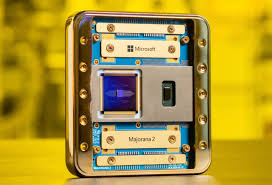

Microsoft’s second-generation Majorana processor replaces aluminum with lead, reports parity stability thousands of times longer than its previous devices, and puts one of quantum computing’s most ambitious ideas under a much sharper experimental test.
Most quantum-computing architectures begin from the same uncomfortable premise: the physical qubit is fragile, so enormous engineering effort must be spent correcting the errors it continually produces. Superconducting transmons, trapped ions, neutral atoms, and spin qubits differ radically in their hardware, but all ultimately confront decoherence and control errors by combining better physical qubits with quantum error correction.
Topological quantum computing begins from a different ambition. Instead of storing a qubit in one local physical degree of freedom, it attempts to distribute quantum information across a nonlocal topological state so that many local disturbances have difficulty changing it in the first place. The appeal is obvious. If the hardware itself suppresses important errors before a conventional error-correcting code sees them, the overhead required for a large fault-tolerant machine could be substantially reduced.
For more than two decades, Majorana zero modes have been one of the leading proposals for realizing that idea. They are predicted to appear at the ends of certain topological superconductors and possess precisely the kind of nonlocal fermionic structure that could encode protected quantum information. The difficulty has been experimental. Semiconductor-superconductor nanowires can produce several signatures associated with Majorana physics, but ordinary Andreev bound states and disorder can imitate many of those signatures. The field has therefore spent years moving from suggestive zero-bias peaks toward increasingly nonlocal measurements that are harder for trivial states to mimic. [1][2][3]
Microsoft has made this difficult route the foundation of its quantum-computing program. Its 2025 Majorana 1 announcement centered on aluminum-based semiconductor-superconductor devices and a tetron architecture designed to store a qubit using four Majorana zero modes. In June 2026, the company announced Majorana 2, built around a substantially different materials stack. Aluminum was replaced with lead, the semiconductor structure was redesigned, and Microsoft reported a characteristic fermion-parity switching time of roughly 20 seconds, with some measurements extending toward a minute. The previous aluminum generation had parity-stability times in the millisecond range. [4][5]
That is an enormous improvement in a quantity that matters for a Majorana architecture. It is also a result that needs to be described carefully. The 20-second number is not the same thing as demonstrating a conventional qubit with a 20-second $T_2$ coherence time, nor does it establish a logical error rate or a complete fault-tolerant gate fidelity. The technical paper measures how long the fermion parity of a nanowire remains stable before switching. Microsoft interprets that stability as evidence that quasiparticle poisoning has been strongly suppressed in its new platform. As of August 2026, the detailed Majorana 2 result is presented in a Microsoft Quantum preprint rather than a peer-reviewed publication. [4]
That distinction makes Majorana 2 more scientifically interesting, not less. The central question is no longer simply whether a device produces a zero-energy feature that resembles a Majorana mode. It is whether the complete hardware architecture begins to exhibit the stability, nonlocality, controllability, and scaling behavior that topological quantum computation requires.
The name comes from Ettore Majorana, who showed in 1937 that relativistic quantum theory permits a fermion that is its own antiparticle. The condensed-matter objects pursued for quantum computing are not usually fundamental Majorana particles flying through space. They are Majorana zero modes, collective quasiparticle excitations that can emerge inside superconducting systems.
The defining mathematical property is compact:
$$ \gamma=\gamma^\dagger $$
An ordinary fermionic annihilation operator $c$ and creation operator $c^\dagger$ are different. A Majorana operator is self-adjoint. One ordinary fermionic degree of freedom can be decomposed into two Majorana operators,
$$ c=\frac{\gamma_1+i\gamma_2}{2} $$
If those two Majorana modes are spatially separated, information associated with the occupation of the corresponding fermionic state becomes nonlocal. A disturbance acting near only one end of a sufficiently long topological wire cannot easily access the complete fermionic degree of freedom.
This separation provides the intuition behind topological protection. In an idealized one-dimensional topological superconductor, Majorana modes live at opposite ends of the wire. Their residual overlap decreases approximately exponentially with the separation $L$,
$$ E_M\propto e^{-L/\xi} $$
where $\xi$ is a characteristic coherence length. The quantity $E_M$ is the splitting generated when nominally separated Majorana modes overlap. Longer wires and a shorter coherence length reduce this unwanted coupling.
The second important scale is the topological gap. Excitations must cross this energy scale to leave the protected low-energy sector through many ordinary processes. A larger gap therefore makes thermal excitations less likely and can shorten the coherence length, improving the separation of the zero modes. Microsoft’s Majorana 2 materials program is largely an attempt to improve these two physical quantities at the device level rather than relying on software to compensate for weak protection later. [4]
A pair of Majoranas is not yet enough for the measurement-based architecture Microsoft is pursuing. Its basic qubit is a tetron, an H-shaped superconducting island formed from two approximately parallel topological nanowires connected by a conventional superconducting backbone. Each horizontal wire is intended to host one Majorana mode at each end, giving four modes in total. The total fermion parity of the island is fixed, leaving a two-dimensional computational subspace that can encode one qubit. [5][6]
If the four Majorana operators are labeled $\gamma_1$ through $\gamma_4$, useful qubit observables can be represented through the parity of pairs. One conventional assignment is
$$ Z=i\gamma_1\gamma_2 $$
and another is
$$ X=i\gamma_1\gamma_3 $$
The significance is physical rather than merely algebraic. Measuring $Z$ means determining the fermion parity associated with one pair of Majorana modes, while measuring $X$ requires a different pair. The logical information is therefore accessed through joint parity measurements rather than by locally asking whether one microscopic object is in state zero or one. Microsoft’s roadmap builds quantum computation around these measurements as the native operation of the processor. [6]
This is quite different from the familiar transmon circuit model. A superconducting transmon is driven through carefully shaped microwave pulses that implement rotations and entangling gates. In Microsoft’s proposed topological architecture, quantum dots are temporarily coupled to selected Majorana modes to form interferometric loops. The parity of the selected modes shifts the energy spectrum and therefore the quantum capacitance of the dots. A microwave resonator senses that shift, converting an otherwise nonlocal fermionic quantity into an electrical readout.
The intended advantage is architectural. If single-qubit and multi-qubit Pauli measurements can be performed directly, many operations required by quantum error-correcting codes become native hardware instructions rather than long decompositions into conventional two-qubit gates. The company’s 2025 fault-tolerance roadmap is built around this measurement-based approach, supplemented by the preparation of magic states for operations that are not supplied by the topological Clifford structure alone. [6]
The material change from Majorana 1 to Majorana 2 is therefore central to the story. Majorana 1 used an indium-arsenide semiconductor structure proximitized by aluminum. Aluminum is a familiar material in superconducting quantum hardware because it forms clean interfaces and is comparatively easy to process, but its superconducting gap is modest. Majorana 2 replaces it with lead, whose substantially larger superconducting gap offers a route toward a larger induced gap in the semiconductor. Microsoft also redesigned the semiconductor active region using indium arsenide and indium arsenide antimonide on a gallium-antimonide-based heterostructure, with the goal of improving spin-orbit coupling while maintaining a clean superconducting interface. [4][5]
The technical preprint reports a roughly $10$ nm lead layer and a parent lead gap of about $1.3$ meV in the device stack. In a two-dimensional test geometry, the team measured a proximity-induced gap around $400$ microelectronvolts. More directly relevant to the topological-wire operating regime, the authors report that the upper portion of their measured topological-gap distribution reaches roughly $70$ microelectronvolts, compared with around $30$ microelectronvolts in the earlier aluminum devices. [4]
A factor of two in gap size may sound much less impressive than a thousandfold change in lifetime, but the connection between them can be highly nonlinear. Thermal excitation rates are exponentially sensitive to an energy barrier relative to temperature. Increasing the gap can therefore produce a disproportionately large decrease in the equilibrium quasiparticle population. The larger gap can also improve localization of the Majorana modes, reducing their overlap across the wire.
The materials problem is unusually demanding because improving one variable can damage another. A superconductor with a larger gap is not automatically better if its interface introduces disorder, if fabrication produces unwanted subgap states, or if the magnetic field required for the topological regime destroys superconductivity. Topological hardware therefore depends on simultaneously controlling superconductivity, semiconductor band structure, spin-orbit coupling, magnetic response, disorder, electrostatic gating, and nanoscale interfaces.
Majorana 2 is best viewed as a materials-engineering result embedded inside a quantum-computing architecture. The large increase in parity stability is valuable precisely because it suggests that a new materials stack has changed the microscopic error environment rather than merely improving the readout electronics.
The measured quantity deserves closer attention because the phrase “20-second qubit lifetime” can easily produce the wrong picture. In a conventional qubit, lifetime often refers to $T_1$, the characteristic time for an excited state to relax, or $T_2$, the time over which a coherent superposition retains its phase information. Neither concept maps directly onto a topological qubit whose computational states are designed to be nearly degenerate.
A Majorana tetron instead has several characteristic failure processes. One is quasiparticle poisoning. An unwanted electron-like quasiparticle enters or leaves the protected superconducting sector and changes fermion parity. Another is Majorana hybridization, in which nominally separated zero modes couple strongly enough to split the qubit states. Measurement errors can also occur even when the physical parity remains unchanged.
The 2026 Majorana 2 experiment focuses on parity stability. The researchers repeatedly measured one nanowire and observed stochastic switching between its two parity states. From these switching records they extracted a characteristic timescale of approximately
$$ T_{\mathrm{parity}}\sim20\ {\rm s} $$
with some intervals reaching roughly one minute. [4]
The same paper places typical operation times in the microsecond regime. The resulting separation between a seconds-scale unwanted parity switch and a microsecond-scale intended operation is potentially enormous. If that separation survives across many devices, operating points, measurement bases, and multi-qubit configurations, it would give an error-correction architecture much more time to interrogate the qubit before a parity-changing event occurs.
However, parity lifetime is only one part of the error budget. A wire could maintain parity while still accumulating coherent phase errors, experiencing residual Majorana splitting, suffering readout mistakes, or failing during multi-qubit operations. The technically meaningful statement is therefore that Majorana 2 reports a very large improvement in one crucial physical stability metric. Turning that metric into a low logical error rate remains the next stage of the experiment.
The reason parity can suddenly change is closely related to the general problem of nonequilibrium quasiparticles in superconducting circuits. Even when a device is cooled to temperatures where thermal excitations should be exceedingly rare, high-energy radiation, cosmic events, imperfect filtering, and other nonequilibrium processes can break Cooper pairs and create quasiparticles. Those excitations can wander through the device and alter the state of a superconducting island.
A larger superconducting gap strongly suppresses equilibrium thermal excitations but cannot automatically stop a sufficiently energetic external event. Microsoft’s technical paper explicitly notes this limitation. The authors argue that the observed 20-second switching time indicates that nonequilibrium quasiparticles are no longer the dominant limitation over the measured operating regime, but that conclusion concerns the tested devices and conditions rather than a theorem guaranteeing immunity to every source of poisoning. [4]
This distinction matters for scaling. A four-device demonstration can be surrounded by elaborate cryogenic shielding and individually tuned with substantial laboratory infrastructure. A machine containing thousands or millions of physical tetrons will present a different environmental problem. Rare radiation events that are negligible for one device can become important across a vast chip. Shared substrates can create correlated disturbances, and error-correcting codes are particularly sensitive to errors that strike many qubits at once.
Topological protection does not remove engineering from quantum computing. It changes which engineering problems are worth solving.
Majorana 2 also addresses another less glamorous problem that may be just as important for scaling: finding the correct operating point. Semiconductor-superconductor devices contain many electrostatic gates, and their phase depends on magnetic field, chemical potential, tunnel couplings, disorder, and local fabrication variations. A large processor cannot be tuned manually wire by wire with the kind of detailed spectroscopy used in early research devices.
The new paper introduces a radio-frequency technique that probes low-energy states near the ends of a wire and can directly resolve their splitting with microelectronvolt-scale precision. Microsoft presents this as part of a faster device “bring-up” procedure for larger tetron arrays. The method is intended to identify operating regions where the wire has a large gap and the Majorana splitting is below experimental resolution. [4]
This is where the company's discussion of artificial intelligence is most relevant. Microsoft says automated and agentic tools assisted aspects of materials development, fabrication analysis, and device tuning. The important scientific advance, however, is not that an AI system somehow discovered Majorana physics. The difficult work remains experimental materials science: fabricating a cleaner hybrid structure, measuring it, finding useful operating regimes, and determining whether the expected topological behavior survives. The AI component is best understood as an attempt to accelerate a high-dimensional experimental optimization problem rather than as a replacement for the underlying physics.
For a scalable processor, this distinction becomes critical. A qubit architecture is not scalable merely because its unit cell is physically small. It must also be possible to manufacture, characterize, tune, calibrate, and operate thousands of those cells without requiring a team of physicists to treat each one as an individual experiment.
The architecture Microsoft ultimately wants is larger than the tetron tested in the paper. Majorana 2 is described as a multi-tetron device, and Microsoft has shown a four-qubit array architecture in which neighboring tetrons share quantum dots and tunable junctions. These shared elements are intended to perform joint parity measurements between qubits, which are necessary for quantum error correction and measurement-based computation. [4][5]
The choice of measurement-based control is closely tied to the limitations of Majorana zero modes themselves. Majorana modes behave like Ising anyons in the ideal topological description. Their braiding operations generate a useful but nonuniversal set of gates. Universal computation therefore requires an additional ingredient, typically magic-state preparation or distillation. Microsoft’s roadmap embraces this rather than attempting to extract a universal gate set from braiding alone. [6]
A scalable processor would consequently contain layers of protection. At the bottom, topological hardware suppresses certain physical errors. Above that, repeated parity measurements detect the remaining errors. A quantum error-correcting code converts many physical tetrons into logical qubits. Magic-state protocols then supply the non-Clifford operations needed for universal algorithms.
Topological quantum computing is sometimes presented as though a Majorana qubit eliminates quantum error correction. It does not. The realistic goal is more subtle: make the physical error model favorable enough that error correction becomes dramatically cheaper.
There is also a serious scientific controversy surrounding the interpretation of these devices, and any useful account of Majorana 2 has to include it.
The fundamental difficulty is that trivial bound states can imitate Majorana signatures. Semiconductor-superconductor nanowires naturally support Andreev bound states. Disorder, smooth electrostatic potentials, quantum dots, and inhomogeneous superconductivity can push these states toward zero energy. Experiments have shown that nontopological systems can produce zero-bias conductance peaks, nearly quantized conductance, and even apparent bulk gap-closing and reopening behavior resembling the signatures expected near a topological phase transition. [2][3]
This history is the reason modern Majorana research increasingly emphasizes nonlocality and parity measurements rather than relying on a zero-bias peak alone.
Microsoft developed what it calls a topological gap protocol, or TGP, combining local and nonlocal conductance measurements to identify candidate topological regions. Its 2023 paper argued that several InAs-Al devices passed this protocol with high probability of entering a topological phase. [7]
That interpretation has been challenged. Henry Legg published detailed arXiv comments in 2025 arguing that the protocol's conclusions can depend strongly on data-selection parameters and that the underlying measurements used in Microsoft's 2025 parity experiment do not establish a clean topological gap. A separate peer-reviewed theoretical study by Hess and collaborators showed that a topologically trivial Andreev band can reproduce the combination of apparent gap closing, reopening, and zero-bias features used by the TGP. [8][9]
These critiques do not automatically prove that Microsoft’s devices are trivial. They establish that the diagnostic problem remains nontrivial. Majorana 2’s long parity lifetime is an impressive measured stability property regardless of interpretation, but stability alone does not demonstrate non-Abelian statistics or exponential topological protection. The new paper continues to use the TGP as part of its identification of the topological regime, so the earlier dispute remains directly relevant to how strongly the word “topological” should be interpreted. [4][8]
This is one reason independent replication will matter so much. A commercially useful topological qubit should eventually make the argument less dependent on interpreting one spectroscopy protocol. It should demonstrate increasingly direct operational consequences of topology: nonlocal correlations, predictable scaling of protection with device parameters, coherent qubit operations, robust multi-axis parity measurements, and ultimately error rates that improve in the characteristic way the topological theory predicts.
The phrase topological protection itself can also be tested quantitatively rather than treated as a label. The underlying theory predicts that separating Majorana modes farther and increasing the ratio between the topological gap and environmental energy scales should suppress certain errors approximately exponentially. If this mechanism is genuinely operating, progressively larger or cleaner devices should show systematic improvements that follow those scaling relations.
This is harder than demonstrating one exceptionally long-lived operating point. Real nanowires contain disorder, multiple subbands, finite length, and imperfect interfaces. A 2026 theoretical analysis of realistic disordered Majorana nanowires found that the regime exhibiting clean exponential protection can be significantly constrained by disorder and wire length. The result reinforces why materials quality is not a secondary fabrication issue but part of the topological physics itself. [10]
Majorana 2 is interesting because Microsoft is explicitly trying to move deeper into the protected regime through materials engineering. The lead superconductor increases the available gap, the semiconductor stack is designed to enhance useful spin-orbit physics, and the wires are made several micrometers long to reduce Majorana overlap. The technical paper reports Majorana splitting below its roughly microelectronvolt measurement resolution over extended parameter regions. [4]
The next convincing result would be to show these pieces forming a consistent scaling law across many devices rather than appearing as separate favorable metrics.
There is another important distinction between detecting Majorana-like modes and using them as a qubit. Condensed-matter experiments have spent more than a decade searching for signatures of Majorana zero modes. A quantum computer needs much more. The modes must be created reproducibly, measured with low assignment error, manipulated without destroying their protection, combined into multi-qubit operations, and operated repeatedly faster than relevant poisoning and dephasing processes.
Microsoft’s own 2025 work illustrates how difficult that transition is. In an aluminum tetron, measurements corresponding to different parity loops produced dramatically different switching times: roughly $12.4$ milliseconds for one loop and only about $14.5$ microseconds for another, with estimated assignment errors that also differed substantially. The authors attributed the two timescales to different physical processes. [11]
Majorana 2’s 20-second result attacks one of these stability problems very strongly, but a useful topological qubit must demonstrate high-quality measurements along all required logical axes and eventually across neighboring tetrons. The relevant benchmark will not be the best lifetime of one wire. It will be the worst important operation in a repeated fault-tolerant cycle.
This is a general lesson in quantum hardware. A processor is only as useful as the complete sequence of operations it can execute reliably.
Microsoft has attached an aggressive roadmap to the new result. The company now says it aims to build a scalable quantum computer by 2029, moving its previous timeline forward. It also remains in the final phase of DARPA programs evaluating whether unconventional quantum architectures can plausibly reach utility scale. These roadmap dates are engineering targets, not experimentally established predictions, and the field has a long history of quantum-computing timelines shifting as new bottlenecks appear.
Majorana 2 nevertheless changes the nature of Microsoft’s bet. A millisecond-scale parity device can be dismissed as too fragile for the architectural promise to matter. A seconds-scale parity-stability measurement forces a more specific discussion. The remaining questions concern whether the underlying states are unambiguously topological, whether the lifetime survives across all measurement configurations, whether operations preserve coherence, whether large arrays can be tuned reproducibly, and whether those physical advantages actually translate into lower logical error rates.
Those are difficult questions, but they are experimentally answerable.
The 2026 result therefore matters less as a declaration that topological quantum computing has been solved and more as a new benchmark against which the architecture can now be tested. If the lead-based platform really provides a larger gap, lower poisoning rate, small Majorana splitting, fast parity readout, and reproducible scaling across arrays, the case for a hardware-protected qubit becomes substantially stronger. If those improvements fail to produce the predicted nonlocal and fault-tolerant behavior, the same experiments will reveal where the topological picture breaks down.
The most interesting part of Majorana 2 is therefore not its branding or even the headline lifetime by itself. It is the attempt to make topology become an engineering resource.
Topological phases are usually discussed through abstract invariants, protected edge modes, and nonlocal quasiparticles. A useful topological computer would have to turn those ideas into measurable hardware advantages: fewer poisoning events, exponentially smaller unwanted splittings, direct joint measurements, compact qubits, and eventually fewer physical devices per logical operation.
Majorana 2 reports substantial progress on the first pieces of that chain. The lead-based InAs platform produces a larger reported topological gap than the earlier aluminum devices, and the measured parity-switching time has increased from millisecond scales to roughly 20 seconds. The tetron architecture already contains the geometry required for measurement-based qubits and can be extended into shared-dot arrays. [4][5]
What remains is arguably the hardest part: proving that the remarkable stability is truly the consequence of the topological physics the architecture was designed to exploit and then showing that this protection survives actual computation.
A zero-bias peak can be imitated. A long parity lifetime can arise without demonstrating every property of a topological qubit. A serious fault-tolerant processor leaves much less room for ambiguity. If repeated logical operations become more reliable as the system is driven deeper into the topological regime, the physics will have to reveal itself through performance.
That is why Majorana 2 is worth watching closely. It is not simply another quantum chip competing on physical qubit count. It is a test of a much more ambitious proposition: that the structure of quantum matter itself can be engineered so that information becomes difficult for the environment to erase.