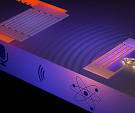

Physicists are learning to control individual quanta of vibration, turning sound inside solid materials into a new platform for quantum information.
Sound normally seems thoroughly classical. Strike a bell and its surface vibrates, pushing the surrounding air into pressure waves that eventually reach our ears. The sound can be louder or quieter, higher or lower in pitch, but nothing about the experience suggests the strange behavior associated with quantum mechanics.
At sufficiently small scales, however, vibration becomes quantum mechanical too. A crystal or mechanical resonator cannot exchange arbitrarily tiny amounts of vibrational energy. Its vibrations can be described in discrete quantum excitations called phonons, which play a role for mechanical motion somewhat analogous to the role photons play for electromagnetic fields. The comparison is not exact, but it leads to a remarkable possibility: if photons can carry quantum information through optical circuits, perhaps phonons can carry quantum information through mechanical ones.
That possibility has developed into the field of quantum acoustics. Researchers can now generate individual phonons, place mechanical vibrations into quantum superpositions, entangle vibrations located in different resonators, interfere phonons with one another, and connect them to superconducting qubits. Experiments published over the past two years have pushed the field toward something much more ambitious than simply observing quantum motion: building actual quantum circuits in which sound itself becomes an information carrier
A phonon is not a tiny particle flying through empty space in the same way we might picture an electron. It is a quantum of collective mechanical vibration. When atoms in a solid move, their motion is coupled because each atom interacts with its neighbors. Instead of treating trillions of atomic movements separately, physicists can describe particular collective vibration patterns as quantum modes, and one unit of excitation in such a mode is called a phonon.
This means an object made from an enormous number of atoms can still display quantum behavior through its collective motion. Mechanical resonators can be fabricated so precisely that particular vibrational frequencies are trapped inside them, somewhat like light being trapped between mirrors in an optical cavity. Cool the resonator sufficiently and control it carefully enough, and researchers can manipulate vibrations one phonon at a time.
That idea connects quantum mechanics to objects much larger than the individual atoms and photons usually associated with the theory. The object itself may be visible under a microscope, yet one particular pattern of motion within it can occupy a quantum state. Quantum acoustics therefore sits at an unusual boundary between microscopic quantum physics and mechanical systems that begin to resemble engineered machines.
Superconducting qubits have become particularly useful tools for controlling these vibrations. A superconducting circuit can be tuned to exchange energy with a mechanical resonator so that an excitation initially stored in the qubit becomes a phonon in the resonator. Later, the process can be reversed and the phonon can be converted back into a qubit excitation for measurement.
This allows a qubit to act almost like an interface between electronic quantum information and mechanical quantum information. Researchers can prepare a desired quantum state using the superconducting circuit, transfer that state into a vibrating structure, allow the mechanical state to evolve, and then retrieve it.
In February 2025, researchers at the University of Chicago demonstrated a particularly striking version of this idea. They used two superconducting qubits connected to two mechanical surface-acoustic-wave resonators fabricated on separate substrates. After first entangling the qubits, they transferred that entanglement into the mechanical resonators. The result was a quantum state shared between the vibrations of two physically separate mechanical objects. They also created more complicated states containing multiple entangled phonons.
Entangling mechanical motion is important because entanglement is one of the central resources of quantum information. A future quantum processor needs more than isolated components capable of behaving quantum mechanically. Those components have to exchange quantum states and create controlled correlations with one another.
Phonons have some unusual properties that make them interesting for this purpose. Mechanical vibrations can be confined to extremely small structures, allowing acoustic components to occupy much less space than electromagnetic resonators operating at similar frequencies. Some mechanical modes can also retain their excitations for relatively long periods when sufficiently isolated. The 2025 experiment emphasized these characteristics as potential advantages for quantum memories, sensing, and distributed quantum systems.
The broader vision starts to resemble an acoustic version of integrated photonics. Instead of routing photons through optical waveguides, a chip could contain structures that generate, split, delay, interfere, store, and detect individual phonons. Quantum information would travel through carefully engineered vibrations of the solid itself.
Controlling the path of a phonon is only part of what would be needed for a genuine acoustic quantum computer. Researchers also need to control its phase, the quantum property that determines how waves interfere. Interference is central to quantum computation because information can be encoded not only in whether an excitation exists, but also in the relative phase between different components of a quantum state.
In 2025, another University of Chicago experiment demonstrated deterministic phase control of traveling one- and two-phonon quantum states. The researchers sent acoustic phonons toward a superconducting transmon qubit and used the interaction between the phonon and the qubit to change the phonon's phase. They then measured the result using an acoustic version of a Mach-Zehnder interferometer, a device concept much more commonly associated with light. [2]
The experiment also demonstrated a method for distinguishing different phonon-number states. Together, phase control and number-resolved detection provide important ingredients for performing quantum operations on traveling phonons rather than merely storing vibrations inside resonators. The researchers argued that this deterministic interaction could provide an advantage over some photon-based approaches, where useful interactions between individual photons can be difficult to produce reliably.
One reason photons dominate discussions of quantum networking is that light is extraordinarily good at carrying information over long distances. Optical fibers can transport photons across cities and countries, while mechanical vibrations normally remain trapped inside the material supporting them. Phonons are therefore unlikely to replace photons for every part of a quantum network.
A more interesting possibility is to combine the two.
Mechanical systems can act as intermediaries between quantum technologies that naturally operate at very different frequencies. Superconducting quantum processors communicate using microwave-frequency signals, while long-distance fiber networks work best with optical photons. Converting quantum information directly between those two domains is difficult. A mechanical mode that interacts with both microwave and optical systems could potentially serve as a bridge.
A 2026 Nature Communications experiment demonstrated low-noise conversion between individual phonons in a nanomechanical resonator and photons at telecommunications wavelengths. The researchers could create a single mechanical excitation and later convert it into a photon suitable for optical communication. Work of this kind is helping develop optomechanical interfaces that could eventually connect stationary quantum processors with long-distance photonic networks.
Researchers are also beginning to build something resembling the acoustic equivalent of wiring. In February 2026, a team reported a compact silicon phononic waveguide actuated using a thin layer of lithium niobate, a strongly piezoelectric material capable of converting electrical signals into mechanical vibration. The structure allowed microwave-frequency signals to couple into phonons traveling through silicon.
The researchers measured mechanical energy relaxation times on the scale of hundreds of microseconds, while also studying frequency fluctuations that caused the mechanical states to lose phase coherence. Those measurements are important because building larger quantum-acoustic circuits requires more than demonstrating that phonons can travel. Engineers need to know exactly how and why the quantum information carried by those vibrations degrades.
This mirrors the development of other computing technologies. Before large processors could exist, engineers needed reliable wires, switches, memories, and methods for understanding noise. Quantum acoustics is beginning to develop its own versions of these components, except the signals traveling through the device are quantized vibrations.
The same sensitivity that makes mechanical quantum systems difficult to protect can also make them powerful detectors. A mechanical resonator responds when even a tiny amount of energy is deposited into one of its vibrational modes. If researchers can detect individual phonons, then the threshold for detecting an external disturbance becomes extraordinarily small.
This has led to a surprising connection between quantum acoustics and searches for new fundamental physics. In 2025, researchers proposed using superconducting qubits coupled to bulk acoustic resonators as extremely low-energy phonon detectors. Certain hypothetical dark-matter particles or other exotic physical processes could deposit tiny amounts of energy into the resonator, creating phonons that would then be transferred to the qubit for detection. The proposed architecture could probe ultralight dark matter, dark photons, and extremely high-frequency gravitational-wave signals in regimes that are difficult to reach with conventional detectors.
The experiment would not literally “hear” dark matter in the ordinary meaning of sound. Instead, new physics would produce minute mechanical excitations inside a solid, and quantum-acoustic technology would make those excitations measurable. Nevertheless, the analogy captures something remarkable: some of the weakest signals in the universe may eventually be detected as individual quanta of vibration.
Quantum acoustics still faces major limitations. Mechanical modes lose energy, their phases are disturbed by material defects and environmental fluctuations, and the interfaces required to control them can themselves introduce noise. In the traveling-phonon platform demonstrated in 2025, phonon lifetimes remained in the microsecond range when strongly connected to the qubit, limiting how large an acoustic quantum circuit could become without substantial improvements.
There is also no reason to assume that phonons will simply replace superconducting qubits or photons. Each physical carrier has different strengths. Superconducting circuits provide strong nonlinear interactions and excellent electrical control. Photons are exceptional for long-distance communication. Mechanical resonators can be compact and may offer useful storage properties. The most promising architectures may therefore be hybrid systems in which each quantum object performs the task to which it is best suited.
That makes quantum acoustics especially interesting as a field. It is not merely proposing another competitor in the race to find the “best qubit.” It is expanding the set of physical objects that quantum engineers can deliberately control.
For much of the history of quantum mechanics, the most recognizable quantum objects were particles of matter and light. Modern experiments are showing that collective motion can be controlled with many of the same tools. Vibrations involving enormous numbers of atoms can be prepared in nonclassical states, entangled across separate structures, manipulated by quantum gates, converted into photons, and measured one quantum at a time.
The result is a different picture of what a quantum machine might eventually look like. Information does not necessarily have to remain inside one kind of qubit. It could move between electronic states, light, spins, and mechanical motion as different parts of a device perform different functions.
A future quantum processor may therefore contain something surprisingly familiar beneath all of its exotic physics: vibrations traveling through solid material. The difference is that these would not be ordinary sound waves carrying music or speech. They would be some of the smallest possible units of mechanical motion, engineered one phonon at a time to carry quantum information.