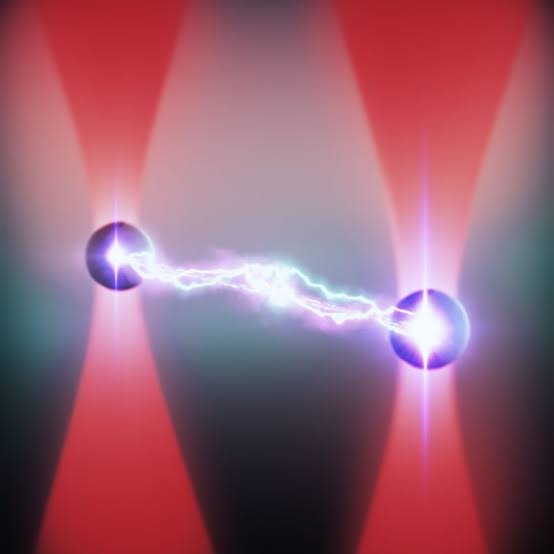

After decades as one of physics’ most theoretical problems, the quantum nature of gravity may finally be approaching experimental tests small enough to fit inside a laboratory.
Modern physics rests on two extraordinarily successful descriptions of nature. Quantum mechanics explains atoms, particles, light, and the microscopic interactions that make matter possible. General relativity explains gravity by treating space and time as a dynamical geometry that bends in response to matter and energy. Each theory has survived demanding experimental tests, yet physicists still do not know how to combine them into a single description of nature.
The difficulty becomes especially clear when something must be treated as both massive and quantum mechanical. Quantum theory allows an object to occupy a superposition of different possible states, including different positions. General relativity says that the position of a mass determines the gravitational field and curvature of spacetime around it. If a mass can be in two places at once, what happens to the gravitational field it creates? Does gravity enter a quantum superposition as well, or does some deeper mechanism prevent this situation from occurring?
For decades, questions like these seemed almost entirely theoretical. The characteristic scales usually associated with quantum gravity are so extreme that no existing particle accelerator can approach them directly. That limitation encouraged the development of ambitious mathematical frameworks such as string theory and loop quantum gravity, but it also left the field with unusually little experimental guidance. A new generation of researchers is now trying to change that by approaching the problem from the opposite direction. Rather than making gravity stronger, they are making quantum experiments vastly more sensitive.
One of the most influential proposals begins with two tiny objects separated by only a short distance. Each object would first be placed into a quantum superposition of two locations. The experiment would then allow the two masses to interact primarily through gravity while carefully suppressing electromagnetic forces and other environmental effects.
Gravity is extraordinarily weak at these scales, but every possible position of the first mass produces a slightly different gravitational interaction with every possible position of the second. If the experiment can preserve the superpositions long enough, those different interactions could alter the combined quantum state of the two objects. Under the original proposals, the result would be detectable entanglement between masses that never directly touched.
This idea is usually associated with proposals independently developed by Sougato Bose and by Chiara Marletto and Vlatko Vedral. The attraction of the experiment is that it does not require researchers to detect an individual graviton or reproduce the conditions inside a black hole. Instead, it turns one of the most recognizable features of quantum information, entanglement, into a possible probe of gravity.
In the simplest interpretation, two isolated quantum systems cannot become entangled through an ordinary classical communication channel. If gravity alone creates entanglement between the masses, then whatever carries that gravitational influence would seem to require quantum properties of its own. The experiment therefore asks a remarkably direct question: can gravity transmit quantum information?
Actually performing such an experiment is enormously difficult. Gravity between microscopic objects is far weaker than the electromagnetic forces that surround them. A stray electric charge, vibration from the laboratory floor, thermal radiation, residual gas molecule, or interaction with the experimental apparatus can overwhelm the signal or destroy the delicate quantum superposition before gravity has enough time to produce a measurable effect.
Researchers therefore need to push several technologies forward simultaneously. Small objects must be trapped and cooled with exceptional control. Their positions must be placed into increasingly large quantum superpositions. Environmental interactions must be suppressed without also eliminating the gravitational interaction being studied. The resulting states then have to be measured precisely enough to distinguish genuine gravity-induced correlations from ordinary noise.
This is why the development of tabletop quantum gravity is closely connected to progress in quantum sensing, optomechanics, atomic physics, and levitated nanoparticles. Technologies designed for seemingly separate areas of quantum science are gradually reaching a regime where the mass of an object and the coherence of its quantum state can both become experimentally important. Nature highlighted this convergence in 2025 as one of the reasons direct tests of gravity’s quantum character are beginning to look experimentally plausible rather than purely hypothetical.
The interpretation of gravity-mediated entanglement has also become more complicated. The original argument suggested that entanglement would provide unusually clean evidence that gravity cannot remain completely classical. More recent theoretical work has challenged how universal that conclusion really is.
A 2025 paper in Nature constructed models described as classical theories of gravity that could nevertheless produce entanglement under particular conditions. The result triggered a debate over what assumptions are required before entanglement can be treated as definitive evidence that the gravitational field itself is quantum. Other physicists have argued that the quantum behavior in such models ultimately enters through the treatment of matter rather than through a genuinely classical mediator.
This debate does not make the experiments less useful. It makes them more scientifically interesting. Fundamental experiments rarely answer enormous questions with a single yes-or-no measurement. Instead, they eliminate classes of theories. A successful result could rule out broad families of models in which gravity and quantum matter interact in particular classical ways, while later experiments impose stronger constraints.
The search for quantum gravity may therefore begin less like discovering a new particle and more like Bell’s transformation of quantum foundations. Bell experiments did not merely demonstrate that quantum mechanics was strange. They progressively ruled out increasingly broad classical explanations of the observed correlations. Tabletop gravity experiments could eventually perform a similar role for theories attempting to keep spacetime classical while matter remains quantum
Entangling two masses is not the only strategy. Another experimental program is searching for possible quantum structure in spacetime itself.
The proposed Gravity from Quantum Entanglement of Space-Time experiment, or GQuEST, uses highly sensitive optical interferometry. Interferometers divide light along different paths and later recombine it, allowing extraordinarily small changes in distance or phase to become measurable through interference. The basic technique is already responsible for some of the most sensitive instruments ever constructed, including gravitational-wave detectors.
GQuEST takes the idea in a different direction. Certain approaches to quantum gravity predict microscopic fluctuations or correlations in spacetime that could leave an extremely small signature on propagating light. Rather than trying to produce quantum gravity using a massive object, the experiment would search for whether spacetime itself introduces measurable effects into an exquisitely controlled optical system. APS described the proposal in 2025 as a new strategy for bringing quantum-gravity phenomenology into laboratory-scale experiments.
The distinction between the approaches is important. Gravity-mediated entanglement experiments ask how gravity behaves when interacting with matter already placed into a quantum state. Interferometric experiments ask whether spacetime possesses quantum fluctuations that can be detected directly through their influence on light. Both are attempts to reach the same frontier from different experimental directions.
An even more surprising possibility involves the graviton, the hypothetical quantum particle associated with the gravitational field in many quantum descriptions. Individual gravitons have traditionally been regarded as essentially impossible to detect because gravity couples so weakly to matter. A detector capable of efficiently absorbing individual gravitons seemed likely to require absurdly unrealistic conditions.
Quantum sensing has forced researchers to reconsider parts of that assumption. A 2024 theoretical proposal showed that massive quantum acoustic resonators could, under particular conditions, exhibit detectable signatures associated with single-graviton processes. Rather than trying to observe a graviton as if it were a photon arriving at a telescope, the proposal uses an extremely sensitive mechanical quantum system and searches for discrete changes in its state.
More recent work has continued investigating possible signatures of graviton emission and absorption. These proposals remain extraordinarily ambitious and do not mean that a single-graviton detector is about to appear in a laboratory. Their importance is conceptual: technologies developed for controlling individual phonons, photons, atoms, and mechanical excitations are allowing physicists to formulate experiments that would previously have been dismissed as fundamentally inaccessible.
The broader experimental race is driven by two technological trends that are gradually approaching one another. On one side, scientists are making increasingly large objects behave quantum mechanically. Interference has been demonstrated with large molecules, mechanical resonators can be cooled close to their quantum ground states, and levitated particles are being placed under increasingly precise quantum control.
On the other side, scientists are becoming able to measure gravity at increasingly small scales. Precision force sensors, atom interferometers, mechanical resonators, and optical systems can resolve interactions that would have been inaccessible to earlier generations of experiments.
The unexplored territory lies where these trends meet: an object large enough for its gravitational influence to matter, but isolated enough that its quantum state remains coherent.
This is a very unusual regime of physics. Individual atoms are easy to treat quantum mechanically but produce almost immeasurably weak gravitational fields. Planets produce obvious gravity but behave overwhelmingly classically. Tabletop quantum-gravity experiments are trying to occupy the enormous gap between those extremes.
These experiments will not immediately reveal whether string theory, loop quantum gravity, or some entirely different theory provides the final description of spacetime. The first questions are more basic and, in many ways, more important. Can gravity act as a quantum information channel? Can a gravitational field exist in a meaningful quantum superposition? Are there observable quantum fluctuations of spacetime? Can models that keep gravity classical remain consistent with increasingly precise experiments?
In February 2026, APS described several of these experimental directions as approaching a point where researchers may finally begin testing the assumption that gravity must be quantized rather than simply accepting it as a theoretical expectation.
That would represent a major change for the field. Quantum gravity has long been unusual because theoretical possibilities dramatically outnumber direct experimental constraints. Even a result that rules out only one important class of theories would give researchers something the field has historically lacked: evidence from a controlled experiment in the regime where gravity and quantum mechanics meet.
The scale of those experiments may be the most surprising part. Twentieth-century fundamental physics became associated with increasingly large machines, from kilometer-scale accelerators to observatories spanning continents. Quantum technology offers another route. Greater control can sometimes substitute for greater energy. If researchers can prepare extraordinarily delicate states and measure extraordinarily weak interactions, the frontier of fundamental physics can move onto an optical table.
The first convincing evidence that gravity itself possesses quantum properties may therefore arrive without creating a microscopic black hole or reaching unimaginable collision energies. It could come from a pair of suspended particles, an interference pattern of photons, or a tiny mechanical resonator responding to a signal almost unimaginably small.
For a field devoted to understanding the structure of spacetime across the entire universe, some of its most important experiments may turn out to be remarkably small.