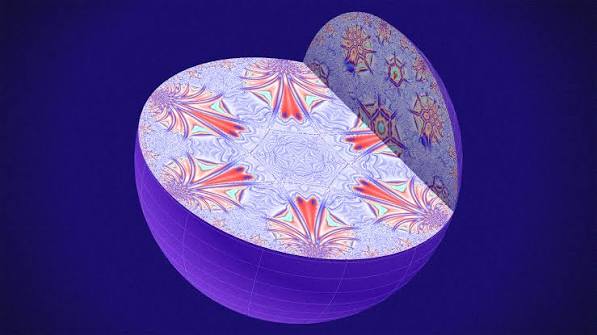

AdS/CFT suggests that spacetime is encoded redundantly in quantum information. New work is asking whether the code itself must become imperfect before gravity can truly emerge.
The AdS/CFT correspondence begins with one of the most radical claims in theoretical physics: a gravitational theory living in a higher-dimensional spacetime can be equivalent to a quantum field theory with no gravity living on its lower-dimensional boundary. Juan Maldacena first proposed the correspondence in 1997 in a precise setting involving string theory on anti-de Sitter space and a conformal field theory. Since then, holography has become one of the central frameworks for studying quantum gravity, black holes, strongly coupled field theories, and the emergence of spacetime itself.
The strange part is not merely that two very different mathematical theories can describe the same physics. The boundary theory appears to contain enough information to reconstruct an entire extra spatial dimension. A quantum field theory with no dynamical gravity somehow encodes particles moving through a gravitational bulk, horizons, geometric distances, and regions of spacetime that do not correspond to any obvious local object on the boundary.
Understanding how that encoding works has become one of the deepest problems in holography. Over the past decade, an unexpected answer has emerged from a field that was originally developed for a completely different purpose: quantum error correction.
To see why error correction appears at all, it helps to forget gravity for a moment and think about ordinary data storage. If one physical bit contains one piece of information, destroying that bit destroys the information. Error-correcting codes avoid this by distributing logical information across many physical degrees of freedom. No individual component needs to contain the entire message. Instead, the information exists in correlations spread across the system.
Quantum error correction uses the same broad principle while respecting the much stranger rules of quantum information. A logical quantum state is encoded into a larger physical system so that some of its components can be lost without destroying the encoded state.
AdS/CFT seems to possess a remarkably similar redundancy.
A particle located deep inside the AdS bulk does not generally correspond to one unique microscopic location in the boundary CFT. Under appropriate conditions, the same bulk operator can be reconstructed using different boundary regions. Remove one part of the boundary and the bulk information may still survive in what remains. This observation led Almheiri, Dong, and Harlow to argue in 2014 that bulk locality in AdS/CFT naturally behaves like a quantum error-correcting code.
The proposal changes how the holographic dictionary should be imagined. The boundary is not a pixelated screen where each small patch stores the corresponding patch of the interior. Bulk information is encoded nonlocally and redundantly across boundary degrees of freedom.
That redundancy may be exactly what allows an apparently local gravitational spacetime to emerge from an underlying quantum system that has no obvious spatial resemblance to it.
The geometry becomes much more precise when entanglement enters the story.
In 2006, Shinsei Ryu and Tadashi Takayanagi discovered one of the most important formulas in modern quantum gravity. For a region chosen on the boundary of a static holographic spacetime, its quantum entanglement entropy is related to the area of a minimal surface extending through the bulk and anchored to the edge of that boundary region.
This was extraordinary because the two sides of the relationship seem to belong to different scientific languages. Entanglement entropy is a property of a quantum state in the boundary field theory. Area is geometry in the gravitational bulk. Yet holography connects them directly.
The minimal surface does more than calculate an entropy. Together with the chosen boundary region, it encloses a portion of the bulk known as the entanglement wedge. Roughly speaking, this wedge identifies the part of the gravitational spacetime whose information is accessible from that boundary region.
Increase the size of the boundary region and its entanglement wedge usually grows deeper into the bulk. Reduce the region and the reconstructable bulk shrinks. In sufficiently complicated states, the wedge can even change discontinuously when one extremal surface becomes favored over another.
Geometry is therefore behaving like a map of information access.
The question “Where is this point in spacetime?” begins to acquire a second meaning: “Which subsets of the boundary contain enough quantum information to reconstruct it?"
This leads to entanglement-wedge reconstruction. Work by Dong, Harlow, Wall and others established that, within the semiclassical regime, bulk operators inside the entanglement wedge associated with a boundary region can be represented using operators supported on that boundary region.
Now imagine a bulk particle near the center of AdS. Several different large boundary regions may each possess entanglement wedges containing that point. The particle can therefore have several different boundary representations.
At first this looks contradictory. How can the same physical operator exist in several different places?
Quantum error correction makes the answer much less mysterious. A logical operation on encoded quantum information can often be implemented through different collections of physical qubits. Those physical operations may look completely different, yet within the protected code space they perform the same logical transformation.
The bulk operator behaves like a logical operator.
The microscopic boundary CFT behaves like the physical quantum system storing it.
This is not merely a metaphor layered onto AdS/CFT after the fact. The mathematics of operator-algebra quantum error correction became deeply connected to precise statements about which bulk observables can be reconstructed from which boundary regions. The JLMS relation, which connects relative entropy in a boundary region to relative entropy in its bulk entanglement wedge at leading semiclassical order, provided another important bridge between the information-theoretic and gravitational descriptions
The most famous attempt to make this picture concrete is the HaPPY code, introduced by Fernando Pastawski, Beni Yoshida, Daniel Harlow, and John Preskill in 2015. The model constructs a hyperbolic tensor network from special highly entangled tensors. Degrees of freedom in the interior act as logical inputs, while degrees of freedom at the edge act as the physical output of a quantum error-correcting code.
The network reproduces several qualitative features expected from holography. Minimal cuts through the tensor network play a role analogous to Ryu-Takayanagi surfaces. Bulk operators can be pushed through the network and represented on different boundary regions. Losing some boundary tensors does not necessarily destroy a deeply encoded bulk degree of freedom.
The geometry of the network and the error-correcting properties of the code become nearly the same object.
That is the remarkable conceptual leap. Spacetime geometry is no longer merely something that quantum information happens to inhabit. The pattern by which information is encoded may itself determine which geometric notions emerge.
A bulk point far from the boundary is highly protected because reconstructing it requires a sufficiently large boundary region. A point near the edge is easier to reach and less redundantly encoded. In this simplified picture, radial depth begins to resemble code distance.
The farther into the emergent spacetime information lies, the more boundary information can potentially be erased before that bulk information becomes unrecoverable.
In an exact holographic code, a protected logical degree of freedom can be reconstructed after an allowed erasure with no error at all. That mathematical cleanliness is useful for understanding why redundant reconstruction is possible, but real gravity does something these fixed codes struggle to reproduce: matter changes geometry.
Put energy into spacetime and spacetime responds. Move matter around and areas change. A black hole grows when energy falls into it. In a gravitational theory, the geometry cannot remain a fixed background independent of the quantum state occupying it.
Yet exact subsystem quantum error correction tends to make the analogue of the geometric area contribution too rigid. Recent work by ChunJun Cao, Gong Cheng, Krishnanand Karthikeyan, Cathy Li, and John Preskill argues that this is not a minor defect of particular toy models but a structural limitation of exact complementary recovery. Their 2026 proposal replaces perfect recovery with approximate quantum error correction, allowing the effective geometric area to become state dependent and respond to the matter encoded in the bulk.
In their framework, a small amount of controlled imperfection is not simply noise that ruins the holographic code. It is what allows the code to behave more like gravity.
That reverses the usual intuition from quantum computing. There, the ideal goal is often to make logical information increasingly independent of microscopic errors. In holography, exact independence may erase precisely the state dependence needed for gravitational backreaction. An imperfect code may therefore describe spacetime better than a perfect one.
The 2026 work introduces an even more unusual ingredient: quantum magic. In quantum information, stabilizer states and Clifford operations form a highly structured sector that is important for quantum error correction and can often be simulated efficiently on classical computers. Universal quantum computation requires resources outside that stabilizer structure, collectively referred to as non-stabilizerness or magic.
Cao and collaborators argue that a particular form of nonlocal, multipartite magic in the encoding map can control the coupling between bulk matter and the effective geometry in their approximate holographic codes. Their construction suggests that entanglement alone may not capture every ingredient required for a dynamical spacetime.
This is a subtle but potentially important shift. A popular slogan in holography has been that spacetime is built from entanglement. That remains deeply influential, but real semiclassical gravity may require a richer quantum-information structure than entanglement by itself.
Edward Witten examined this approximate-reconstruction picture in a June 2026 note. He emphasized a tension that had already been visible in exact holographic error correction: if entanglement-wedge reconstruction were exact under the relevant assumptions, the area contribution associated with the Ryu-Takayanagi prescription would effectively become state independent, eliminating ordinary gravitational backreaction.
Witten analyzed perturbations away from exact reconstruction and found that, in the framework under consideration, the reconstruction error can be exponentially smaller than the corrections responsible for changes in the effective area. In other words, geometry may respond appreciably to the quantum state even while entanglement-wedge reconstruction remains extraordinarily accurate.
That is precisely the regime holography would like to possess. Bulk physics should appear local and reliably reconstructable, but gravity must still know that matter is present.
The lesson is that “approximate” does not necessarily mean “bad.” An exponentially tiny failure of exact quantum error correction may coexist with the much larger state-dependent effects we recognize as gravitational geometry.
An even more fundamental challenge appeared in July 2026. Seiji Terashima argued that entanglement-wedge reconstruction should be separated from the stronger claim that AdS/CFT literally realizes holographic quantum error correction in the same way as HaPPY-type codes. In his analysis, ordinary finite-N holographic CFTs may not possess the exact protected invisible sectors required for one region-independent bulk logical operator to have code-preserving representatives on several distinct boundary regions. He instead advocates a form of “subregion complementarity,” in which different boundary regions possess their own region-adapted descriptions of the bulk.
This is a current theoretical argument, not an established overthrow of holographic quantum error correction. The QEC framework has accumulated deep connections to bulk reconstruction, entropy formulas, relative entropy, tensor networks, and black-hole information. But the new debate is useful because it separates several ideas that are sometimes merged together too quickly.
One claim is that boundary subregions can reconstruct appropriate bulk information.
A stronger claim is that all of those reconstructions should literally be regarded as interchangeable representatives of one exact logical operator in a conventional quantum code.
Real gravitational systems may satisfy the first statement only approximately or in a more algebraic and state-dependent sense.
That distinction becomes increasingly important once finite-N corrections and gravitational dressing are taken seriously. A local bulk excitation in gravity is not completely independent of the gravitational field extending toward the boundary, so the notion of a perfectly localized, region-independent logical operator becomes more subtle than it is inside an idealized tensor network.
This debate reveals how far the relationship between gravity and quantum information has developed. The interesting question is no longer simply whether AdS/CFT “looks like” a quantum error-correcting code. Researchers are asking which notion of code is appropriate, how exact the recovery can be, how gravitational dressing modifies logical operators, whether area should be represented by an operator or a state-dependent function, and what resources beyond entanglement are necessary for dynamical geometry.
These are much sharper questions than the original slogan that spacetime emerges from quantum information.
The emerging picture suggests that semiclassical spacetime may correspond to a very special regime of quantum encoding. Information must be sufficiently redundant that bulk locality survives partial loss of the boundary. It must be sufficiently entangled that geometric areas and entropies are connected. Yet the encoding cannot be so rigid that matter is unable to deform geometry.
The deepest lesson of entanglement-wedge reconstruction may therefore be more subtle than saying that the universe is a quantum code.
Quantum error correction provides a language for understanding why information that appears localized in a gravitational interior can be spread nonlocally across a boundary theory, why multiple boundary regions can recover overlapping parts of the same bulk, and why losing microscopic information need not immediately destroy semiclassical spacetime. The recent work pushes the analogy further by asking where it fails.