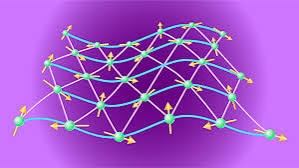

In quantum spin ice, frustrated atomic magnets can reorganize themselves into an emergent version of electrodynamics, complete with photon-like waves, fractionalized charges, monopole excitations, and a gauge field that does not exist in the microscopic crystal.
A conventional magnet becomes understandable once its microscopic moments choose an ordered pattern. In a ferromagnet they align, in an antiferromagnet neighboring spins point against one another, and the resulting order can often be summarized by a local quantity such as magnetization. Quantum spin liquids behave differently. Strong interactions constrain the spins, yet quantum fluctuations prevent them from settling into an ordinary ordered state even at extremely low temperature. The result can be a long-range-entangled phase whose natural description is no longer simply a collection of atomic magnetic moments. New particles and new fields emerge from the collective organization of the spins.
Among the most remarkable examples is quantum spin ice. Its low-energy physics can behave like a compact $U(1)$ gauge theory, a close mathematical relative of electromagnetism. The effective theory contains an emergent electric field, an emergent magnetic field, charged quasiparticles called spinons, and a gapless collective mode whose dispersion resembles that of light. This excitation is therefore called an emergent photon. It is not an ordinary photon of the electromagnetic field and it will not shine visibly out of the crystal. It is a collective oscillation of the material's internal gauge field, created entirely by interactions among spins. The striking point is that the long-distance equations can take essentially the same form as Maxwell's theory even though no microscopic Maxwell field was inserted into the magnetic Hamiltonian. The possibility of such “pyrochlore photons” was developed theoretically more than two decades ago and remains one of the clearest examples of gauge fields emerging from many-body quantum matter.
The experimental case has strengthened dramatically. In 2025, polarized-neutron scattering and thermodynamic measurements on the pyrochlore compound $\mathrm{Ce_2Zr_2O_7}$ found low-energy magnetic excitations and higher-energy fractionalized signatures consistent with the photon and spinon sectors expected for quantum spin ice. The measured heat capacity also showed behavior consistent with the $T^3$ contribution expected from linearly dispersing gapless bosons in three dimensions. The authors described the material as a strong candidate for a dipolar-octupolar quantum spin ice rather than claiming that every aspect of the emergent gauge theory had been unambiguously established.
In 2026 the effort has shifted toward separating these excitations more cleanly. New spectroscopy theory has developed field-dependent signatures that distinguish the low-energy emergent photons from the higher-energy spinon continuum, while other work proposes thermodynamic and nanoscale-magnetometry probes aimed directly at the characteristic gauge-field energy scale. Quantum spin ice is therefore moving from the question of whether unusual continua exist toward the much sharper problem of spectroscopically resolving the individual particles of an emergent quantum electrodynamics.
The story begins with geometry. Pyrochlore magnets place magnetic ions on a network of corner-sharing tetrahedra. Each spin typically prefers to point approximately along its own local axis connecting the center of a tetrahedron to one of its corners. If interactions favor the spin-ice regime, the lowest-energy configurations satisfy a simple local constraint: on every tetrahedron, two spins point inward and two point outward. This is the magnetic two-in, two-out ice rule. The terminology comes from the analogous proton constraint in ordinary water ice, where local bonding rules produce a macroscopically large number of allowed configurations rather than one unique ordered ground state.
Represent the local orientation of the four spins on tetrahedron $t$ by Ising variables $\sigma_i=\pm1$. A useful effective charge is
$$ Q_t=\sum_{i\in t}\sigma_i $$
The ice rule becomes simply
$$ Q_t=0 $$
because two $+1$ and two $-1$ contributions cancel. The important feature is not merely that many configurations satisfy this equation. The same local condition can be rewritten as a discrete version of Gauss's law.
To see this, assign a directed field variable to every link of the dual diamond lattice. The microscopic spins then act like discrete pieces of an effective electric field $\mathbf{E}$. The two-in, two-out constraint says that as much field flows into every tetrahedron as flows out. At long wavelengths,
$$ \nabla\cdot\mathbf{E}=0 $$
This is already the source-free Gauss law of electromagnetism.
Nothing electromagnetic had to be placed into the original magnetic model. The equation arises because frustrated spins are restricted to a particular subset of configurations. A local rule on a tetrahedron becomes a divergence constraint on a coarse-grained field.
That change in language is the first essential step from a frustrated magnet to an emergent gauge theory.
The divergence-free constraint has measurable consequences even before quantum mechanics is added. A field satisfying
$$ \nabla\cdot\mathbf{E}=0 $$
cannot fluctuate arbitrarily. In momentum space, its correlations take a transverse form resembling
$$ \langle E_i(\mathbf{k})E_j(-\mathbf{k})\rangle\propto\delta_{ij}-\frac{k_ik_j}{k^2} $$
The second term removes the longitudinal component because the field cannot develop a source within the ice-rule manifold.
When neutron scattering measures the spatial correlations of a classical spin ice, this transverse structure produces distinctive singular patterns called pinch points in momentum space. They are the diffraction fingerprint of an emergent Coulomb phase: a disordered magnet whose correlations are governed by a divergence-free gauge constraint rather than conventional long-range magnetic order. Quantum spin ice inherits this gauge structure but makes the field itself dynamical.
This is an important distinction between disorder and a spin liquid. A completely random paramagnet is disordered because its spins are largely uncorrelated. Spin ice is disordered because there are exponentially many configurations satisfying a highly structured local rule. The absence of conventional order is therefore accompanied by strong correlations.
The material is not failing to organize.
It is organizing around a constraint instead of an order parameter.
The ice rule also explains why unusual particles appear. Suppose one spin is flipped inside a perfect two-in, two-out configuration. Because each spin belongs to two neighboring tetrahedra, the flip changes both. One tetrahedron can become three-in, one-out while its neighbor becomes one-in, three-out.
Their effective charges are now nonzero:
$$ Q_t\neq0 $$
In the continuum gauge description, the corresponding equation becomes
$$ \nabla\cdot\mathbf{E}=\rho $$
where $\rho$ represents the density of emergent gauge charge.
In classical spin ice these defects behave as magnetic-monopole-like quasiparticles. They are not fundamental Dirac monopoles of the actual electromagnetic field. They are collective defects made from many microscopic magnetic moments, but at long distances their interactions can display an effective Coulomb structure. Moving one defect through the lattice requires flipping a sequence of spins, leaving behind a chain often described as an emergent Dirac string. The endpoint defects can nevertheless separate from one another rather than being permanently confined by an energy cost proportional to the length of the string.
Quantum spin ice enriches this language. The emergent $U(1)$ gauge theory possesses electric charges, commonly identified with spinons, as well as magnetic topological excitations associated with gauge flux. The exact terminology varies between microscopic formulations, so the monopole-like defects of classical spin ice should not be carelessly identified with every object called a monopole in the quantum gauge theory. What matters is the deeper principle: excitations that appear inseparable at the microscopic spin level can become independent particles in the effective theory.
This phenomenon is fractionalization.
Fractionalization is one of the defining ideas of quantum spin liquids. A microscopic operation acts on one physical spin, yet the excitation it creates can separate into multiple quasiparticles that propagate independently. The quantum numbers carried by the observable excitation are therefore reorganized relative to the microscopic degrees of freedom.
In the emergent gauge description, a spinon acts as a source of the effective electric field:
$$ \nabla\cdot\mathbf{E}=\rho_s $$
where $\rho_s$ is the spinon charge density.
Two such charges interact through the emergent gauge field. At long distances the potential has the Coulombic structure
$$ V(r)\propto\frac{q_1q_2}{r} $$
up to material-dependent constants.
This resemblance to electrodynamics is deeper than a convenient analogy. The spinons are gauge charges, and the field mediating their long-range interaction is the same field whose transverse oscillations become emergent photons. In other words, quantum spin ice can contain both the analogue of charged matter and the analogue of light within the same many-body system. Hermele, Fisher, and Balents showed that the three-dimensional $U(1)$ spin-liquid phase supports such a stable deconfined gauge structure, and later microscopic studies established realistic pyrochlore Hamiltonians in which Coulombic quantum liquids and spinons can appear.
The microscopic crystal contains neither free spinons nor this gauge photon as fundamental ingredients. They exist only because an enormous number of spins collectively organize into the quantum spin-liquid phase.
Classical spin ice provides the constrained manifold, but quantum mechanics is what makes the emergent field truly dynamical. A simplified microscopic quantum-spin-ice Hamiltonian contains a dominant Ising interaction together with smaller transverse terms,
$$ H=J_z\sum_{\langle ij\rangle}S_i^zS_j^z-J_{\perp}\sum_{\langle ij\rangle}(S_i^+S_j^-+S_i^-S_j^+) $$
The $J_z$ term establishes the ice constraint. If it dominated completely, the system would resemble a classical spin ice with a huge number of nearly degenerate two-in, two-out configurations. The transverse term allows quantum transitions between them.
However, an arbitrary single-spin change generally violates the ice rule and costs energy. The lowest-order processes that remain entirely inside the constrained manifold therefore involve coordinated motion around closed loops. On the pyrochlore lattice, an important process flips spins around hexagonal loops. The resulting low-energy Hamiltonian has a ring-exchange structure that can be written schematically as
$$ H_R=-K\sum_p(O_p+O_p^\dagger) $$
where $p$ labels an elementary loop and $O_p$ converts one allowed ice configuration around that loop into another.
The ground state is therefore not simply one two-in, two-out pattern. Quantum mechanics creates a coherent superposition of many allowed spin-ice configurations.
That quantum superposition is what turns a static Coulomb constraint into a quantum Coulomb phase.
The ring-exchange model can be rewritten using a compact gauge potential $A$ conjugate to the emergent electric field $E$. On a lattice, the gauge field lives on links, while the circulation of $A$ around a plaquette defines an emergent magnetic flux. In the long-wavelength limit,
$$ \mathbf{B}=\nabla\times\mathbf{A} $$
and the effective Hamiltonian takes the Maxwell-like form
$$ H_{\mathrm{eff}}=\frac{1}{2}\int d^3x\left(U\mathbf{E}^2+K\mathbf{B}^2\right) $$
where $U$ and $K$ are effective stiffnesses determined by microscopic spin interactions.
These are the same two types of terms that appear in ordinary electromagnetic-field energy: one associated with an electric field and one with a magnetic field. Small transverse fluctuations then satisfy wave equations whose low-momentum dispersion is linear:
$$ \omega_{\gamma}(\mathbf{k})=v_{\gamma}|\mathbf{k}| $$
The excitation is the emergent photon.
Its velocity $v_{\gamma}$ is not the speed of light. It is set by microscopic energy scales and lattice dimensions in the magnetic material. The photon also does not represent oscillations of the fundamental electromagnetic vector potential. It is the Goldstone-like gapless mode of an emergent gauge field associated with the spin-liquid state.
Yet mathematically its low-energy propagation resembles light sufficiently closely that calling it a photon is more than metaphor. The same gauge principle that makes ordinary photons transverse and gapless reappears as an emergent property of interacting spins.
This leads to a profound example of emergence. At microscopic scales the system consists of localized magnetic moments governed by exchange interactions. At long wavelengths, those microscopic variables are no longer the most efficient language. The relevant degrees of freedom behave as gauge fields and fractionalized charges.
The logic resembles other collective phenomena but goes further. Sound waves emerge from atoms even though no single atom contains a sound wave. A phonon is therefore an emergent quasiparticle. Quantum spin ice adds another layer because the low-energy theory does not merely create a new particle. It creates a redundant gauge description and its associated force field.
The effective theory possesses transformations of the form
$$ \mathbf{A}\rightarrow\mathbf{A}+\nabla\chi $$
that leave the physical emergent magnetic field unchanged,
$$ \mathbf{B}\rightarrow\mathbf{B} $$
This is the same mathematical gauge redundancy found in ordinary electromagnetism. The microscopic Hamiltonian never needed to possess an actual electromagnetic vector potential corresponding to $\mathbf{A}$. Gauge structure has appeared because the low-energy Hilbert space is constrained.
This is one reason quantum spin liquids matter well beyond magnetism. They demonstrate explicitly that gauge theories need not be fundamental ingredients of a microscopic model. They can emerge from quantum entanglement and local constraints.
The photon also leaves a thermodynamic signature. A gapless bosonic mode with linear dispersion in three spatial dimensions has a low-energy density of states proportional to $\omega^2$. Its contribution to the specific heat therefore behaves like
$$ C_{\gamma}\propto T^3 $$
at sufficiently low temperature.
This is mathematically similar to the $T^3$ specific heat produced by acoustic phonons, another set of linearly dispersing bosons. The challenge is that a real crystal already contains ordinary phonons, nuclear contributions, spinons, disorder, and other excitations. Identifying a small emergent-photon term requires separating several overlapping signals.
The 2025 $\mathrm{Ce_2Zr_2O_7}$ study combined polarized neutron scattering with thermodynamics for precisely this reason. It found near-zero-energy magnetic scattering together with behavior in the magnetic heat capacity consistent with the cubic temperature dependence expected from linearly dispersing emergent photons. At higher energies the neutron response displayed features associated with a spinon continuum. The combination is considerably stronger than observing either signal in isolation because the emergent $U(1)$ theory predicts both sectors.
Even so, identifying an emergent photon is harder than detecting an ordinary sharp quasiparticle. The relevant energy scale can be extremely low, and other scattering near zero energy can obscure it. Current research is therefore developing probes that distinguish the photon from spinons by how each responds to momentum, energy, magnetic field, temperature, and polarization.
Neutrons are particularly valuable because they couple directly to magnetic moments. The central measured object is closely related to the dynamical spin structure factor,
$$ S(\mathbf{q},\omega)=\sum_n|\langle n|S_{\mathbf{q}}|0\rangle|^2\delta(\omega-E_n+E_0) $$
This quantity records how strongly a spin operator with momentum $\mathbf{q}$ can create an excited state with energy $\omega$.
An ordinary magnet with sharp magnon excitations often produces well-defined dispersing peaks in $S(\mathbf{q},\omega)$. Fractionalization changes this pattern. A neutron can inject one unit of microscopic spin but the resulting excitation can break into multiple spinons. Because the energy and momentum can be shared between them in many different ways, the response becomes a broad continuum rather than a single quasiparticle line.
The emergent photon lives at much lower energy and has its own characteristic momentum dependence. The 2025 neutron measurements on $\mathrm{Ce_2Zr_2O_7}$ found precisely this qualitative separation: low-energy magnetic excitations consistent with photons and higher-energy spectral weight associated with fractionalized spinons.
A 2026 spectroscopy study sharpened the distinction by calculating how a weak magnetic field separates and reshapes the two sectors in dipolar-octupolar quantum spin ice. At zero field, photon and spinon responses can overlap with nonmagnetic backgrounds. Under carefully chosen fields, their characteristic signatures can become more clearly demarcated.
The problem is gradually becoming analogous to particle spectroscopy: identify the field's different excitations through their distinct dispersion, polarization, and response to external parameters.
The particular candidate $\mathrm{Ce_2Zr_2O_7}$ adds another layer of gauge physics because evidence points toward a $\pi$-flux quantum spin ice rather than the simplest zero-flux state. Earlier thermodynamic, susceptibility, and neutron-scattering analyses constrained its effective interactions and argued that the material lies in or near a $U(1)_{\pi}$ spin-liquid regime with unusual dipolar-octupolar character.
The difference between zero flux and $\pi$ flux is not an ordinary magnetic field threaded through the crystal. It refers to the background flux of the emergent gauge field through elementary loops.
For a loop $p$, define an emergent gauge flux
$$ \Phi_p=\sum_{\ell\in p}A_{\ell} $$
A zero-flux state has approximately
$$ \Phi_p=0 $$
while a $\pi$-flux state has
$$ \Phi_p=\pi $$
modulo $2\pi$.
A spinon moving around such a loop accumulates a gauge phase
$$ e^{i\Phi_p}=-1 $$
in the $\pi$-flux case. This changes interference between spinon paths and can dramatically restructure their band dispersion and scattering continuum. The background gauge flux therefore leaves observable fingerprints even though it is not a conventional electromagnetic flux measurable with an ordinary magnetometer. Theoretical work has used such symmetry fractionalization and spinon spectral structure to distinguish candidate forms of quantum spin ice.
This is condensed-matter physics operating remarkably close to lattice gauge theory: matter fields move through a fluctuating gauge background whose flux pattern determines their quantum interference.
The phrase dipolar-octupolar describes another feature of several cerium pyrochlores. The effective pseudospin-$1/2$ degrees of freedom are not simple miniature bar magnets. Different components of the pseudospin transform like different magnetic multipoles, including dipolar and octupolar moments. This enlarges the set of possible exchange interactions and allows quantum spin-liquid phases whose observable magnetic response can differ substantially depending on which pseudospin component hosts the emergent gauge field.
This makes experimental interpretation harder but also makes the materials more interesting. Neutron scattering couples naturally to magnetic dipoles, while an octupolar component can be comparatively hidden. A quantum spin liquid may therefore possess strong internal quantum dynamics that appear weakly in one experimental channel and more strongly in another.
The 2022 analysis of $\mathrm{Ce_2Zr_2O_7}$ placed the material near the boundary between dipolar and octupolar quantum-spin-ice character. The 2025 polarized-neutron work then argued that its new low-energy measurements favor a dipolar-octupolar quantum spin ice with dominant dipolar Ising interactions.
The continuing refinement matters because detecting a quantum spin liquid involves more than showing that a material fails to order. A credible identification should simultaneously explain the microscopic exchange couplings, thermodynamics, static correlations, excitation spectrum, magnetic-field response, and expected fractionalized sectors.
The emergent photon is particularly striking because it illustrates that massless particles can emerge from a lattice containing no microscopic massless particle. The crystal certainly has a lattice spacing and strong microscopic interactions, yet the long-wavelength gauge theory develops a mode whose energy vanishes continuously as momentum approaches zero:
$$ \lim_{|\mathbf{k}|\rightarrow0}\omega_{\gamma}(\mathbf{k})=0 $$
The absence of a gap is protected by the gauge structure of the deconfined phase rather than by an accidental fine-tuning of one oscillator frequency.
This mirrors ordinary electrodynamics, where gauge invariance forbids a conventional photon mass unless the gauge structure is altered, as happens effectively in a superconductor through the Higgs mechanism. Quantum spin ice possesses its own analogue of this logic. A deconfined $U(1)$ spin liquid has a gapless photon, while condensation of gauge-charged matter can drive a Higgs transition into a different phase, and proliferation of magnetic defects can drive confinement. The phase diagram can therefore contain transitions that are naturally described using the language of high-energy gauge theory rather than ordinary magnetism.
The microscopic material and the emergent field theory are not competing explanations. They apply at different scales. One specifies which atoms interact and how; the other identifies the collective variables that survive at long wavelengths.
These transitions are one reason programmable quantum simulators could become valuable. A real material gives nature one fixed crystal structure and a limited set of tunable parameters. An engineered atom array can allow interactions, detunings, geometry, and fields to be varied deliberately.
A 2025 Physical Review X proposal showed how three-dimensional Rydberg atom arrays could realize a $U(1)$ quantum spin-liquid regime related to quantum spin ice on the pyrochlore lattice. The theoretical phase diagram contains a deconfined gauge phase and routes toward both confinement and Higgs transitions. The work is a proposal for realization rather than an experimental demonstration of the three-dimensional QSI phase, but it provides a blueprint for building spin-ice gauge physics from individually controlled atoms.
A simplified Rydberg-array Hamiltonian has the structure
$$ H=\frac{\Omega}{2}\sum_i\sigma_i^x-\Delta\sum_i n_i+\sum_{i<j}V_{ij}n_in_j $$
where $\Omega$ drives transitions between atomic states, $\Delta$ controls the excitation energy, and $V_{ij}$ represents the strong interaction between Rydberg excitations.
The geometry and blockade constraints can then be engineered so that low-energy atomic configurations map onto constrained dimer or spin-ice configurations. Instead of waiting for a naturally occurring material to sit at the desired point in parameter space, the simulator could deliberately move through the phase diagram.
Such a device would turn an emergent gauge theory into something experimentally programmable.
Entanglement provides another route to diagnosing the phase. A quantum spin liquid is not simply a classical mixture of many ice configurations. Its low-energy state contains coherent superpositions and multipartite entanglement, which means measurements designed to quantify many-body quantum correlations can reveal information invisible to a conventional order parameter.
A 2026 Nature Communications study investigated quantum Fisher information as a thermal and dynamical probe of quantum spin ice. Using quantum Monte Carlo, exact diagonalization, and gauge mean-field theory, the authors found that the momentum- and temperature-dependent Fisher information distinguishes ferromagnetic order, critical behavior, zero-flux QSI, and $\pi$-flux QSI, while also resolving crossovers from a high-temperature paramagnet through classical spin ice into the quantum-spin-ice regime. Because suitable forms of quantum Fisher information can be related to experimentally measurable dynamical response functions, the approach offers another way to connect entanglement structure to neutron spectroscopy.
This is important because conventional symmetry-breaking phases are identified by what becomes nonzero. Quantum spin liquids often require the opposite style of reasoning: combine multiple nonlocal, dynamical, and fractionalization-sensitive measurements until one effective gauge theory explains them simultaneously.
The experimental signature is therefore a pattern rather than one number.
Researchers are also looking for ways to detect the emergent photon without relying entirely on bulk neutron scattering. A recently accepted 2026 Physical Review Letters study proposes using stray-field magnetometry to detect the magnetic noise generated by emergent photon fluctuations near the surface of a quantum spin-ice material. The method exploits the fact that although the gauge field is emergent, the microscopic spins producing it carry real magnetic moments, so their correlated fluctuations can generate measurable magnetic fields outside the sample.
This creates an intriguing bridge between emergent gauge physics and quantum sensing. A nanoscale magnetic probe placed near the material would not detect the internal gauge vector potential directly. Instead, it would measure real stray-field noise whose frequency and spatial structure encode the photon correlations.
The distinction is subtle but important. The emergent photon is not escaping from the crystal as an ordinary electromagnetic photon. Its internal spin fluctuations leave a secondary electromagnetic signature that a sufficiently sensitive external sensor could measure.
If such approaches become experimentally practical, quantum spin ice may eventually be studied using local probes rather than only large neutron facilities.
Thermodynamics may provide another route. An August 2026 preprint proposed a method for detecting the low-energy ring-exchange scale that controls important gauge excitations in quantum spin ice. The difficulty is that the photon bandwidth and other low-energy gauge-sector features can be obscured in ordinary heat-capacity measurements by nuclear contributions or by the broader spinon sector. The proposed strategy uses derivatives of experimentally tunable observables, including differences in thermal expansion coefficients or the temperature derivative of magnetization under weak fields, to isolate the underlying energy scale. The theory further predicts that the sign of certain responses can distinguish zero-flux from $\pi$-flux QSI states.
This is a useful development because the emergent gauge theory contains an internal hierarchy of energies. The spinon gap, ring-exchange scale, photon bandwidth, and magnetic topological excitation scale need not coincide. Measuring only a broad specific-heat peak can blur these components together.
The next stage of the field is therefore increasingly spectroscopic. Rather than merely establishing the absence of magnetic order, experiments aim to assign particular measured features to particular quasiparticles of the effective gauge theory.
That is exactly how a new particle theory becomes experimentally mature.
A deeper reason these systems attract attention is that they provide a physical realization of a concept central to modern theoretical physics: the same low-energy field theory can arise from microscopic systems that look completely unrelated.
Maxwell electromagnetism in vacuum begins with the electromagnetic gauge field as part of the fundamental description. Quantum spin ice begins with magnetic ions in a crystal. Yet after the high-energy microscopic degrees of freedom are coarse-grained away, both can contain a transverse $U(1)$ gauge field with linearly dispersing photons and charged matter.
The emergent fields are not identical to fundamental electromagnetism, but their mathematical relationship is sufficiently close that concepts such as Gauss's law, Coulomb interactions, photons, gauge charge, flux, confinement, and Higgs transitions transfer naturally between them.
This gives condensed matter an unusual role in fundamental theory. A crystal can become a laboratory for mechanisms normally discussed in quantum field theory.
Gauge fields stop being purely formal abstractions and become collective variables that can potentially be imaged, perturbed, spectroscopically resolved, and driven across phase transitions.
The analogy also has limits that make quantum spin ice more than a miniature copy of electromagnetism. The emergent gauge field is compact, the lattice provides a microscopic ultraviolet structure, spinons can possess unusual symmetry fractionalization, and the effective coupling strength can differ drastically from that of ordinary QED. The background gauge flux can be zero or $\pi$, and different microscopic materials can realize dipolar, octupolar, or mixed forms of the spin liquid. The emergent photon's velocity and bandwidth are determined by exchange interactions rather than universal constants.
The lattice can therefore produce phenomena with no simple counterpart in vacuum electromagnetism.
The same gauge structure that creates the photon can also reorganize the translational and crystal symmetries experienced by spinons. In a $\pi$-flux phase, a spinon acquires nontrivial phases while moving through elementary loops, changing its effective band structure. Magnetic fields can modify the spinon sector and help expose otherwise overlapping photon features. The material provides a version of electrodynamics intertwined with crystal symmetry and strong correlations.
This is why the phrase emergent quantum electrodynamics is more accurate than simply saying that the material imitates light. The gauge field is an organizing principle for the entire low-energy many-body phase.
The present experimental status requires a careful balance between excitement and precision. Theoretical quantum spin ice is well established as a possible stable phase of three-dimensional frustrated magnets, and several pyrochlore compounds have displayed important pieces of the expected phenomenology. For $\mathrm{Ce_2Zr_2O_7}$, the 2025 polarized-neutron and thermodynamic measurements strengthened the interpretation in terms of emergent photons and fractionalization, but the paper itself describes the material as a strong candidate, reflecting the broader challenge of distinguishing nearby quantum phases and separating overlapping low-energy signals.
That uncertainty is driving better experiments rather than weakening the idea. Field-dependent spectroscopy is being designed to separate photons from spinons. Quantum Fisher information offers another diagnostic of the entangled phase structure. Stray-field magnetometry may provide a direct local probe of photon fluctuations. Thermodynamic spectroscopy has been proposed to isolate the ring-exchange scale and distinguish flux sectors. Three-dimensional Rydberg arrays offer a synthetic route where the gauge Hamiltonian itself can be tuned.
These approaches attack the same problem from different directions: establish not merely that a magnet behaves strangely, but that its low-energy world truly contains the particle and field content predicted by an emergent $U(1)$ gauge theory.
The broader significance of quantum spin ice lies in how radically it changes the notion of what can exist inside matter. A material is normally described as being made from electrons and nuclei interacting through known fundamental forces. That remains microscopically true. Yet collective quantum organization can create a second layer of effective reality whose particles have their own charges, interactions, fluxes, selection rules, and gauge fields.
At that level, the relevant objects are no longer simply the original spins.
A spin flip can fractionalize into independently moving spinons. A local ice constraint becomes Gauss's law. Coherent loop fluctuations become an emergent magnetic field. Long-wavelength oscillations of that field become photons. Background quantum phases become gauge flux. Changing the interactions can produce analogues of confinement and the Higgs mechanism.
The remarkable part is that none of these ingredients had to be fundamental.
They are generated by the quantum state of the material.
This is the central promise of quantum spin liquids: sufficiently entangled matter can contain an effective universe of quasiparticles governed by laws that are not obvious from its microscopic constituents. Quantum spin ice is one of the clearest cases because the emergent law is already familiar. At long wavelengths, a lattice of frustrated magnets can begin speaking the language of electrodynamics.
The crystal does not literally produce ordinary light.
It does something conceptually stranger: it creates a new kind of light whose field exists only because the spins collectively decide that Maxwell's equations are the correct low-energy rules.