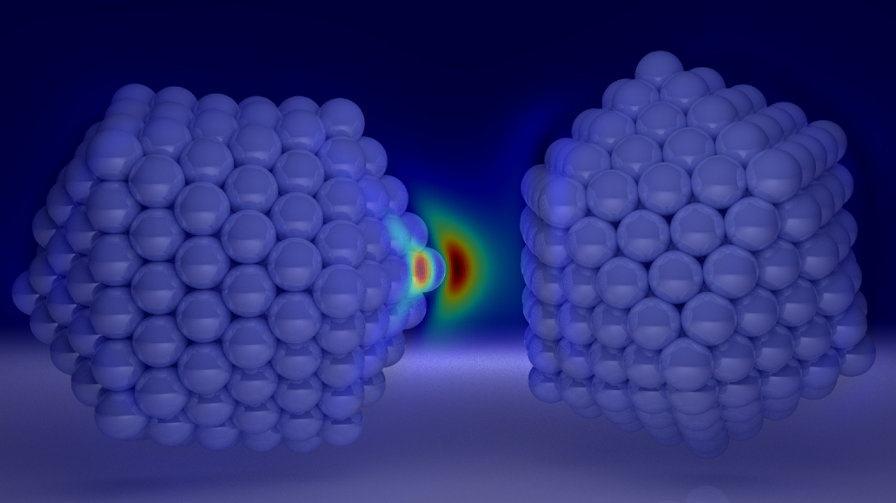

In 2026, physicists made metal nanoparticles containing thousands of atoms interfere like waves, pushing quantum superposition into a regime where our classical intuition becomes increasingly difficult to defend.
Quantum mechanics was never supposed to apply only to tiny things. The theory does not contain a rule saying that an electron can exist in a superposition but a sufficiently large object cannot. The same mathematical principles should, in principle, apply to atoms, molecules, pieces of metal, laboratory equipment, and everything else built from quantum matter.
The problem is that the world around us looks nothing like this. A baseball does not appear along two trajectories at once. A grain of dust does not spread across a room as a matter wave. Macroscopic objects seem to occupy definite places and follow definite histories, even though every atom inside them obeys quantum mechanics.
For more than a century, this tension has driven one of the deepest questions in physics: whether the classical world emerges naturally from quantum mechanics or whether quantum theory itself eventually fails when objects become sufficiently large. In January 2026, an experiment published in Nature pushed that question into a new regime. Researchers observed matter-wave interference from sodium nanoparticles containing more than 7,000 atoms and masses exceeding 170,000 atomic mass units. The experiment produced the strongest matter-wave test of quantum superposition at this level of macroscopicity yet reported.
The experiment was performed using an apparatus called MUSCLE, the Multi-Scale Cluster Interference Experiment. Researchers produced cold clusters of sodium containing roughly 5,000 to 10,000 atoms and sent them through a sequence of three diffraction gratings formed by ultraviolet laser light. Instead of mechanical slits cut into a piece of material, these standing light waves interacted with the nanoparticles and controlled which parts of their matter waves could continue through the interferometer.
The particles themselves were around eight nanometers across, comparable to the length scales of some structures in modern semiconductor devices. Yet during the experiment, their center-of-mass quantum state became delocalized across paths separated by about 133 nanometers, more than an order of magnitude larger than the physical size of the nanoparticle itself. The researchers were not simply observing uncertain knowledge about which route a classical particle had taken. When the possible paths were recombined, they produced an interference pattern that agreed with the quantum prediction and differed from the corresponding classical model.
That distinction is crucial. A classical particle could travel through an apparatus along a route we do not happen to know. Quantum interference requires something stronger. The alternatives must retain phase relationships capable of affecting one another when they later recombine. The experiment therefore treats the center of mass of an entire nanoparticle containing thousands of atoms as one coherent matter wave.
The strange behavior normally introduced using electrons and photons had survived inside a small lump of metal.
This experiment belongs to a much longer effort to increase the scale of matter-wave interference. Electron diffraction established the wave nature of electrons almost a century ago. Experiments later demonstrated interference with neutrons, atoms, and increasingly complex molecules. In 2019, researchers reported quantum interference with organic molecules containing as many as roughly 2,000 atoms and masses above 25,000 atomic mass units. At the time, those molecules were among the most massive objects whose center-of-mass motion had been clearly demonstrated to interfere quantum mechanically.
Moving from large organic molecules to metallic nanoparticles changes more than the number printed beside the object's mass. A nanoparticle begins to resemble the kinds of objects we normally think of as pieces of material rather than individual molecules. Thousands of atoms contribute collective electronic, thermal, and mechanical degrees of freedom, creating many opportunities for information about the particle's path to escape into its environment.
This is where the experiment connects directly to decoherence, one of the central ideas behind the quantum-to-classical transition.
Quantum interference survives only while the different components of a superposition retain the coherence required to interfere. If the environment acquires enough information about which path the particle followed, those phase relationships become inaccessible and the interference fades. A collision with a gas molecule can carry away path information. So can scattered light or thermal radiation emitted by the particle itself. Decoherence theory describes how these uncontrolled interactions can make a fundamentally quantum system behave increasingly classically without requiring the underlying laws of quantum mechanics to suddenly switch off.
This provides a powerful explanation for why quantum behavior becomes so difficult to observe as systems grow. Larger objects contain more particles, interact with more environmental degrees of freedom, and can radiate or scatter more information about their state. A microscopic superposition may survive long enough to manipulate in a laboratory, while an uncontrolled macroscopic object can decohere extraordinarily rapidly.
But decoherence leaves a subtle conceptual issue unresolved. It explains why interference becomes effectively impossible to observe once information has spread into the environment, but standard quantum mechanics still assigns a quantum state to the complete system consisting of the object and its environment. The theory itself has not introduced a fundamental size above which superposition ceases to exist.
Some physicists have therefore investigated a more radical possibility: perhaps quantum mechanics really does change at sufficiently large scales.
Objective-collapse models modify ordinary quantum dynamics by adding a physical mechanism that gradually destroys sufficiently macroscopic superpositions. Instead of collapse occurring only as part of the traditional measurement postulate, localization becomes an actual dynamical process. Microscopic particles can remain quantum for long periods, while sufficiently massive or widely separated states become increasingly unstable. Continuous Spontaneous Localization, or CSL, is one of the best-known examples. Gravity-related ideas developed by Lajos Diósi and Roger Penrose propose another possibility in which large spatial superpositions become unstable because different branches correspond to different gravitational configurations.
The important point is that collapse models are not merely interpretations of quantum mechanics. Once a theory changes the equations governing physical evolution, it can produce experimentally different predictions. A sufficiently large matter wave might lose interference more rapidly than ordinary environmental decoherence predicts. Some collapse models also predict small amounts of extra heating, motion, or radiation.
This turns a philosophical disagreement into experimental physics.
If researchers can account for known sources of decoherence and still observe interference from increasingly massive objects, they eliminate portions of the parameter space in which a proposed collapse mechanism could operate. Every successful large-scale superposition experiment therefore does more than demonstrate that quantum mechanics is strange. It tells us where any hypothetical failure of quantum mechanics cannot occur. Matter-wave experiments have long been used precisely for this purpose.
The 2026 sodium experiment pushed that constraint considerably further. The researchers quantified their result using a measure known as macroscopicity, originally developed to compare very different tests of large quantum superpositions. Instead of deciding whether something is “macroscopic” using mass alone, the measure asks how strongly an experiment rules out a broad class of modifications that would force sufficiently large systems to behave classically.
The sodium nanoparticle experiment reached a macroscopicity value of 15.5, which the researchers report as an order-of-magnitude improvement in the tested classicalization timescale compared with previous experiments. This is a more meaningful statement than simply calling the experiment the “largest Schrödinger cat,” because the strength of a quantum test depends on several features at once. A heavy object placed into two states separated by an unimaginably tiny distance is physically different from a lighter object whose wave function is spread over a much larger region. The duration for which coherence survives matters too.
This distinction also explains why apparently contradictory quantum records can all be meaningful. Mechanical resonators can contain vastly more mass than the sodium particles while being placed into superpositions separated by fantastically small distances. Atomic interferometers can separate wave packets by enormous distances relative to atomic size while containing much less mass. Matter-wave nanoparticle experiments occupy another part of this landscape by combining substantial mass with spatial delocalization larger than the dimensions of the object itself.
The goal is not simply to make the heaviest possible object quantum. Researchers are trying to expand the territory over which quantum mechanics has been directly tested.
That territory is being attacked from directions that look completely unrelated. Matter-wave interferometers search for disappearing interference. Mechanical resonators search for anomalous motion or heating. Atomic systems test coherence for long periods. Remarkably, even detectors built for particle astrophysics are now contributing.
In March 2026, the XENON Collaboration used the XENONnT dark-matter detector to search for x-rays that certain dynamical-collapse models predict should be emitted spontaneously. The experiment found no such signal and placed new limits on both CSL and Diósi-Penrose-type models. For the Markovian CSL model considered in the analysis, XENONnT excluded values in the originally proposed parameter ranges for the first time, while also improving constraints on the Diósi-Penrose model.
A detector containing tonnes of liquid xenon deep underground and a nanoparticle interferometer firing tiny pieces of sodium through laser gratings seem to belong to entirely different areas of physics. Yet both are now testing the same underlying possibility: whether the linear quantum dynamics used in ordinary quantum mechanics is exactly correct.
Gravity adds another layer to the problem. Penrose and Diósi independently explored ideas in which sufficiently different mass distributions in a superposition might be unstable because they correspond to different gravitational configurations. If such a mechanism exists, increasing the mass and spatial separation of quantum objects could eventually reveal a deviation from ordinary quantum evolution.
Experiments have already constrained simple versions of these proposals. A 2021 experiment conducted underground at Gran Sasso searched for spontaneous radiation associated with a gravity-related collapse model and ruled out the natural parameter-free version of the Diósi-Penrose proposal tested there. The 2026 XENONnT analysis tightened related constraints further.
This does not prove that gravity has nothing to do with the quantum-classical transition. It shows something more scientifically useful: specific mathematical models can be proposed, tested, and eliminated. The vague statement that “gravity might collapse the wave function” becomes increasingly constrained once it has to survive real data.
That is one reason large-superposition experiments matter to fundamental physics. They do not require researchers to agree beforehand about the interpretation of quantum mechanics. The experiment asks whether standard quantum predictions continue to work. So far, as the tested scale has increased, they have.
The 2026 experiment is also important because the frontier has not stopped at 170,000 atomic mass units. In the same work, the researchers studied how their interferometer could be pushed toward particles in the million-Dalton range. At sufficiently high masses, the present experimental conditions make classical and quantum predictions increasingly difficult to distinguish, but their calculations indicate that slowing future nanoparticles could restore the clear separation needed for a decisive interference test.
Metal nanoparticles are particularly useful because their mass, temperature, polarizability, charge, and material composition open possibilities that differ from earlier molecular interferometers. The authors also point toward experiments with complex nanobiological objects occupying comparable mass ranges. The goal would not be to claim that biology somehow becomes uniquely quantum. It would be to ask whether increasingly complex objects continue to obey exactly the same center-of-mass superposition principle that works for atoms and molecules.
That progression makes the next stage of the field unusually interesting. The question is no longer whether quantum interference exists beyond individual particles. That has been known for decades. The challenge is to push coherent delocalization into regimes where mass, complexity, environmental interaction, and perhaps gravity all become difficult to ignore simultaneously.
There may never be a sharply defined “quantum-classical boundary.” The evidence could continue supporting the idea that classical behavior is emergent: large objects appear classical because maintaining observable coherence becomes overwhelmingly difficult as information leaks into their surroundings. If so, a perfectly isolated object would have no fundamental upper mass limit beyond which quantum mechanics stops applying.
Alternatively, some future experiment could reveal a small but reproducible loss of coherence that cannot be explained by ordinary environmental interactions. Such a result would be extraordinary because it would indicate that the quantum theory used throughout modern physics is an approximation to something deeper.
Either outcome makes pushing the scale worthwhile.
The 2026 sodium experiment did not make a macroscopic everyday object visibly exist in two places at once, and it did not solve the measurement problem. What it did was more precise. It took a nanometer-sized piece of metal containing thousands of atoms, delocalized its center-of-mass state across distances much larger than the object itself, recombined those alternatives, and recovered the interference predicted by quantum mechanics.
Once again, nature refused to reveal a size at which the quantum rules simply stop.
The boundary between the quantum and classical worlds has not disappeared. But experiments are steadily pushing it away from the microscopic domain where textbooks first taught us to expect quantum mechanics, and toward objects that increasingly resemble ordinary matter.
For now, the strangest conclusion remains the simplest one: the world may look classical not because quantum mechanics ends, but because seeing its quantum character becomes extraordinarily difficult.