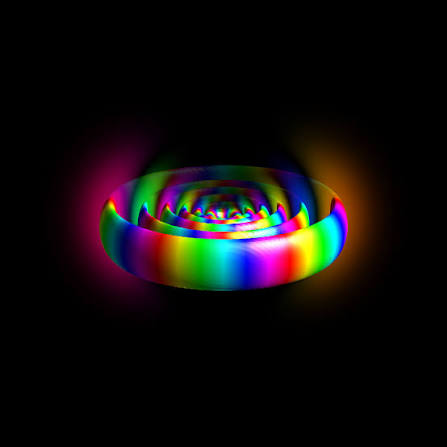

Quantum many-body scars reveal rare pathways through Hilbert space where interacting quantum systems repeatedly recover memories they should have lost.
Put a hot object next to a cold one and eventually their temperatures approach equilibrium. Stir cream into coffee and the original pattern disappears. Release a gas into a larger container and it spreads. These processes look so ordinary that thermalization can seem almost inevitable: sufficiently complicated systems forget the microscopic details of how they began and settle into behavior determined by a few macroscopic quantities such as energy.
Quantum mechanics makes this expectation more subtle, but for generic interacting quantum systems the basic idea survives. A many-particle state evolves through an enormous space of possible configurations, entanglement spreads, local information becomes increasingly difficult to recover, and observables approach values consistent with thermal equilibrium. This behavior is closely connected to the eigenstate thermalization hypothesis, or ETH, which provides one of the main explanations for how thermal physics can emerge from reversible quantum dynamics.
Quantum many-body scars are an exception hidden inside this picture. They are unusual states embedded within systems that otherwise behave chaotically and thermalize normally. Prepare the system in certain special configurations and, instead of rapidly forgetting where it started, it can repeatedly return close to its initial state. The many-body wave function appears to travel through an enormous Hilbert space while remaining unusually concentrated around a tiny set of preferred trajectories.
The phenomenon first emerged experimentally in a somewhat unexpected way. In 2017, researchers used an array of 51 individually controlled neutral atoms to study interacting quantum dynamics. Each atom could be excited into a highly energetic Rydberg state, where interactions between nearby atoms become extremely strong. The experiment created an ordered configuration and suddenly changed the system's parameters, allowing the many-body state to evolve far from equilibrium.
Ordinary thermalization would suggest that the initial order should rapidly disappear. Instead, the experiment observed persistent oscillations in which the atomic pattern repeatedly weakened and then partially returned. The system seemed to retain an anomalously strong memory of the state from which it had started.
The original experiment did not set out to discover a new kind of quantum scar. The interpretation came afterward. In 2017 and 2018, theoretical work by Christopher Turner, Alexios Michailidis, Dmitry Abanin, Maksym Serbyn, Zlatko Papić and collaborators identified a small family of exceptional eigenstates inside the effective model describing the Rydberg experiment. These eigenstates strongly violated the behavior expected from ordinary thermalizing states and had unusually large overlap with the experimentally prepared initial configuration. The researchers named them quantum many-body scars.
Traditional quantum scars were discovered in systems containing effectively a single particle moving through a classically chaotic environment. Imagine a particle bouncing around a stadium-shaped billiard. Classical trajectories usually become extremely complicated, but a few unstable periodic orbits repeatedly trace the same geometric route. Quantum mechanics can produce eigenstates whose probability density becomes unusually concentrated near those unstable classical paths, leaving visible “scars” in the quantum wave function.
The many-body version is more surprising because the relevant space is no longer ordinary physical space. A chain of interacting atoms can occupy an enormous number of possible many-particle configurations. The number of those configurations grows exponentially as particles are added, so the system's quantum state evolves through a high-dimensional Hilbert space rather than merely moving around a two-dimensional billiard.
A many-body scar therefore does not usually look like a literal line burned into physical space. Its structure appears in the organization of quantum states across Hilbert space. Certain exceptional eigenstates have unusually low entanglement, unusual expectation values, and strong overlap with special initial states compared with neighboring eigenstates at similar energies.
The Rydberg experiment can be approximately described by a model now famous in quantum many-body physics: the PXP model. Its unusual name comes from the structure of the allowed transitions, but the crucial ingredient is a physical constraint known as the Rydberg blockade.
When one atom is excited into a Rydberg state, its strong interaction with nearby atoms can prevent its nearest neighbors from being excited simultaneously. That restriction removes huge numbers of configurations that would otherwise be available to the system. An atom may flip between its states only when the surrounding pattern allows it.
The dynamics therefore resemble motion through a maze whose walls are imposed by quantum interactions. Most routes through that maze lead toward ordinary thermalization, but the special alternating configuration used in the original experiment has unusually strong access to a sequence of scarred states. Those states possess an approximate algebraic structure that helps the system evolve away from the initial configuration and later return toward it, producing the observed revivals.
The revival is not perfect. The scarred sector is embedded inside a much larger thermalizing system, and the state gradually leaks into other parts of Hilbert space. Yet the persistence of repeated oscillations is dramatically stronger than would be expected from a generic initial state.
Quantum scars therefore represent weak ergodicity breaking. The system has not become completely incapable of thermalizing in the way a perfectly localized system might. Instead, a tiny and highly structured collection of states behaves abnormally inside a spectrum dominated by ordinary thermal states.
This creates a remarkable tension with statistical mechanics. If almost every state at a certain energy looks thermal, why should a few neighboring states behave completely differently?
The eigenstate thermalization hypothesis does not simply say that systems become thermal because we lose track of them. It proposes that, in a generic interacting quantum system, individual highly excited eigenstates already encode thermal properties locally. If nearly all relevant eigenstates satisfy ETH, a broad range of initial states naturally approach equilibrium as their phases scramble during evolution.
Scarred eigenstates are conspicuous exceptions. They sit among thermal states at similar energies but contain much less entanglement or unusual local structure. A special initial state that overlaps strongly with several of these scars can therefore evolve coherently through that exceptional subspace instead of immediately dissolving into the thermal background.
The situation has often been compared to finding a small set of perfectly organized rooms hidden inside an overwhelmingly chaotic building. The building remains chaotic. Most paths through it still behave normally. But someone entering through exactly the right doorway can repeatedly encounter structure that generic visitors never see.
This is one reason quantum scars differ fundamentally from many-body localization. In a many-body localized system, disorder can prevent a broad range of states from thermalizing. In a scarred system, thermalization remains the rule.
Experiments have since shown that these revivals are not merely an uncontrollable curiosity. In 2021, researchers using a programmable Rydberg-atom quantum simulator demonstrated that the scarred dynamics could be deliberately strengthened. By periodically changing the system's parameters, they increased the fidelity and lifetime of the revivals, effectively steering the many-body system closer to its special nonthermal trajectory.
This result introduced an important change in perspective. If quantum scars can be stabilized and manipulated, they become more than exceptions to thermalization. They become potential resources for controlling quantum dynamics.
Ordinary chaotic evolution is generally hostile to quantum information stored in a simple initial configuration because that information rapidly spreads throughout the system. Scarred dynamics offer windows in which particular information remains unusually accessible for longer periods. That does not automatically make scars a practical quantum memory, but it raises a broader engineering question: can researchers intentionally construct interacting quantum systems containing protected dynamical pathways?
The problem is almost the reverse of conventional quantum error correction. Error correction tries to detect and repair disturbances that push information out of a protected code space. Scar engineering asks whether the Hamiltonian itself can contain special trajectories that repeatedly guide parts of the state back toward a recognizable configuration.
The scar picture has also expanded beyond the original PXP model. In 2025, researchers showed theoretically that experimentally accessible Rydberg systems with longer-range blockade constraints can support additional families of quantum many-body scars. These generalized models contain different scarred trajectories and can require weakly entangled starting states rather than the simple alternating product state used in the original experiment.
That matters because one of the central questions in the field has been whether quantum many-body scars are rare accidents requiring finely tuned Hamiltonians or whether they represent a broader organizing principle in interacting quantum dynamics.
Another 2025 study took an even wider view. By studying large classes of many-body spin systems, researchers argued that quantum scarring in the dynamical sense can arise much more broadly than the original scarred-eigenstate picture might suggest. Their work identified persistent memory associated with unstable periodic trajectories even in systems that remain thermal and satisfy conventional ETH properties overall.
The terminology here is still developing, and not every phenomenon called “scarring” is identical to the original PXP scars. That distinction is important. Some studies focus on rare nonthermal eigenstates; others focus on enhanced recurrence near unstable many-body trajectories while the full system remains ergodic. Rather than weakening the subject, the differences suggest that quantum scars may belong to a larger family of mechanisms by which structure survives inside many-body chaos.
The phenomenon is now appearing in increasingly different systems. In 2025, an experiment with a spinor atomic gas reported ergodicity breaking and many-body scar behavior in a collective spin system rather than a Rydberg chain. The experiment connected periodic classical trajectories in the system's mean-field dynamics with anomalous quantum states and long-lived oscillations, strengthening the connection between many-body scars and the older theory of scars in quantum chaos.
Other theoretical work has found scars in lattice gauge theories, constrained spin systems, bosonic models, and long-range interacting systems. The field is therefore moving away from treating scars as one peculiar feature of one atomic model and toward asking what general dynamical structures allow interacting quantum systems to preserve memory.
That question cuts across several areas of physics. In statistical mechanics, scars challenge our understanding of thermalization. In quantum chaos, they connect classical unstable trajectories to quantum dynamics. In quantum information, they provide examples of atypically slow scrambling and unusual entanglement growth. In quantum simulation, they offer experimentally visible signatures that programmable many-body devices can reproduce coherent dynamics far from equilibrium.
A particularly interesting development is the use of scars to understand and benchmark quantum simulators themselves. A useful quantum simulator must preserve complex many-body dynamics accurately enough that researchers can trust its results, but verifying a large quantum simulation can become classically impossible for exactly the same reason the simulation is interesting in the first place.
In July 2026, researchers proposed using a special class called stabilizer scars as benchmarks for large-scale nonequilibrium quantum simulation. These states retain the unusual scar property of existing inside complicated many-body dynamics, but their mathematical structure allows their fidelity to be checked efficiently. Under the proposed error model, successfully reproducing the scarred states can provide information about the reliability of nearby simulations whose full dynamics are no longer classically tractable.
This is an elegant use of the phenomenon. A scar is normally interesting because it is an unusually simple island inside a complicated spectrum. That same simplicity can make it a reference point for testing a quantum machine exploring the surrounding complex dynamics.
Quantum many-body scars ultimately expose a surprising fact about thermalization. Forgetting is not simply the inevitable consequence of having many interacting particles. It depends on how quantum states are organized, how constraints reshape Hilbert space, and whether the system contains exceptional structures capable of channeling its evolution.
An enormous Hilbert space can contain enough complexity for almost every state to appear thermal while still hiding a sparse set of states that remember far more than they should. Prepare the wrong initial condition and those states are nearly invisible. Prepare the right one and the entire many-body system can repeatedly reveal them through coherent revivals.
That makes scars valuable even if they never become a technological resource. They provide controlled exceptions to one of the most important emergent principles in physics. By understanding why the exceptions exist, physicists can test how thermal behavior arises in the first place.
The deeper goal is therefore not simply to catalogue systems that fail to thermalize. It is to understand the architecture of quantum chaos well enough to know which parts of Hilbert space forget, which parts remember, and why.
A quantum many-body system may contain billions of possible pathways toward equilibrium. Quantum scars show that a few extraordinary routes can keep leading back home.