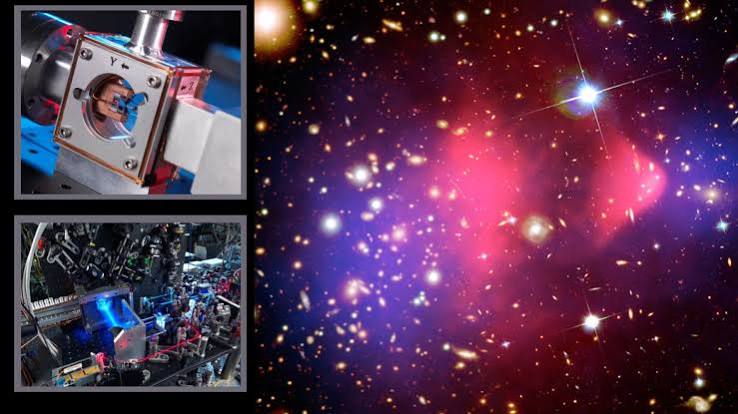

Quantum sensors are using some of the strangest properties of atoms to measure gravity, time, motion, and magnetic fields with extraordinary precision.
Quantum computing tends to dominate conversations about quantum technology. The vision is easy to understand: build machines that use quantum mechanics to solve calculations beyond the reach of ordinary computers. Yet while researchers continue working toward large fault-tolerant quantum computers, another branch of quantum technology is already moving toward practical applications. Instead of using quantum systems to calculate answers, scientists are using them to measure the physical world with levels of precision that conventional instruments struggle to reach.
These devices are known as quantum sensors. Their basic idea is surprisingly simple. Atoms, photons, and other quantum systems respond extremely sensitively to changes in their surroundings. Gravity can slightly alter the motion of an atom. Magnetic fields can shift its internal energy states. Acceleration can change the phase accumulated by matter waves. Time itself can be measured by tracking incredibly stable atomic transitions. Rather than treating this sensitivity as a problem, as quantum-computer engineers often must, quantum sensing turns it into the entire purpose of the device.
One of the clearest examples is gravity. We normally experience gravity as an almost constant downward pull, but Earth's gravitational field changes slightly from place to place. A dense mineral deposit beneath the ground produces a tiny difference in gravity. So can an underground tunnel, a buried structure, changes in groundwater, or movements of magma beneath a volcano. These variations are extremely small, but sufficiently precise sensors can detect them.
Quantum gravimeters can use clouds of ultracold atoms as test masses. Laser pulses manipulate the atoms so that their quantum matter waves travel along different paths before recombining. Gravity changes the relative motion of those paths, leaving a measurable signature. The result is an instrument capable of detecting extraordinarily subtle variations in gravitational acceleration without physically drilling or digging into the ground.
This creates applications that sound almost like science fiction but are based on measurement rather than imaging. Future gravity sensors could help locate underground infrastructure before construction begins, track water stored beneath Earth's surface, monitor volcanic systems, and assist geologists searching for structures hidden below layers of rock.
Quantum sensing could also change navigation. Modern navigation depends heavily on satellite systems such as GPS. A receiver determines its position by comparing precisely timed signals from multiple satellites, which works extremely well as long as those signals remain available. Underground, underwater, inside some buildings, or in environments where satellite signals are blocked or disrupted, GPS becomes far less useful.
An alternative is inertial navigation. If an instrument can continuously measure every acceleration and rotation experienced by a vehicle, it can estimate how its position changes even without an external signal. Classical inertial sensors already do this, but tiny measurement errors accumulate over time and eventually cause the calculated position to drift.
Atom interferometers offer a possible route toward dramatically more precise measurements of acceleration and rotation. Instead of relying only on mechanical components, these systems use the wave-like behavior of atoms as extremely sensitive references. A sufficiently advanced quantum inertial sensor could allow aircraft, ships, autonomous systems, or scientific instruments to navigate for much longer periods without continuously checking a satellite network.
The same philosophy applies to magnetic fields. Quantum systems can be extraordinarily sensitive to magnetism because magnetic fields influence quantities such as electron spin. Researchers can therefore turn atoms, atomic defects in crystals, and other quantum systems into microscopic magnetometers.
One particularly interesting platform uses nitrogen-vacancy centers in diamond. A nitrogen atom next to a missing carbon atom creates a defect whose quantum spin state can be manipulated and read using light. Because that spin responds to its magnetic environment, the defect can function as an extremely small magnetic-field sensor.
The advantage is not simply greater sensitivity. These sensors can potentially measure magnetism on tiny spatial scales, allowing researchers to study magnetic structures that would otherwise be averaged away by larger instruments. Applications range from investigating new materials to studying extremely weak magnetic signals produced by microscopic physical or biological systems.
Perhaps the most successful quantum sensors already surround modern society without most people realizing it: atomic clocks. These devices use extremely stable transitions inside atoms as references for measuring time. The best modern atomic clocks are so precise that relativity becomes noticeable over surprisingly small differences in height. A clock placed higher in Earth's gravitational field can tick at a slightly different rate from one placed below it.
That means an atomic clock is not merely a clock. It can also become a sensor for gravity.
This connection has led to the idea of relativistic geodesy, in which networks of ultra-precise clocks could help measure differences in Earth's gravitational potential. Rather than determining elevation entirely through traditional surveying, scientists could compare how rapidly clocks tick at different locations. Improvements in optical atomic clocks are pushing timing toward the point where subtle gravitational variations themselves become measurable quantities.
The idea demonstrates something unusual about quantum sensing: a device built to measure one quantity can reveal entirely different physics because nature connects those quantities at fundamental levels.
Quantum sensors are also becoming tools for investigating questions for which physicists do not yet know the answer. One of the largest mysteries in modern physics is dark matter. Astronomical observations strongly indicate that much more matter exists in the universe than we can see, but researchers have still not identified what dark matter actually consists of.
Many experiments search for individual dark-matter particles colliding with detectors. Quantum sensors open additional possibilities because some dark-matter theories predict extremely weak changes in quantities such as electromagnetic fields, atomic transition frequencies, or fundamental constants. Instead of waiting for a large collision, researchers can search for tiny coordinated disturbances across highly precise quantum devices.
Atomic clocks, spin-based sensors, atom interferometers, superconducting devices, and quantum networks have all been investigated as possible tools for detecting signatures of new physics. The extraordinary precision developed for quantum technology therefore doubles as a microscope for physical laws that may lie beyond the Standard Model.
This points toward a future in which quantum sensors do not operate only as isolated instruments. Networks of them could compare measurements over cities, countries, or even continents. If many distant sensors recorded the same unusual signal at nearly the same time, researchers could distinguish a genuine physical event from noise affecting only one instrument.
A distributed network of clocks might look for transient changes associated with exotic physics. Networks of magnetometers could search for unusual field patterns. Atom interferometers separated by large distances could contribute to precision measurements of gravity or motion. Quantum communication techniques may eventually improve how some of these sensors coordinate their measurements.
The resulting system would resemble a scientific observatory spread across the planet. Traditional telescopes collect light arriving from distant objects. A quantum-sensor network would instead monitor extremely subtle changes occurring locally in matter, fields, space, and time.
The contrast with quantum computing is important. A useful quantum computer requires researchers to manipulate large amounts of quantum information while preventing noise from destroying a calculation. That is an extraordinarily demanding engineering task. A quantum sensor often needs to control a much smaller quantum system and allow the surrounding physical quantity to influence it in a carefully measured way.
In other words, a quantum computer attempts to isolate a quantum system from much of the outside world so that it can compute. A quantum sensor deliberately exposes a quantum system to one carefully chosen part of that world so that it can measure.
That difference may help explain why quantum sensing could become one of the first areas where quantum technology quietly becomes part of ordinary infrastructure. Its impact may not arrive as one dramatic machine suddenly outperforming every classical computer. Instead, it could appear gradually through better navigation, underground mapping, medical and materials research, precision timing, geological monitoring, and experiments probing physics we have not yet discovered.
Quantum technology is often presented as a race toward computation, but computation is only one way of using quantum mechanics. Nature also offers extraordinary sensitivity, and learning how to control that sensitivity may prove just as transformative. The first quantum revolution gave us transistors, lasers, and modern electronics. The next one may give us instruments capable of detecting changes in the world that were previously too small to observe at all.
Quantum computers promise to change what we can calculate. Quantum sensors may change what we are able to see.