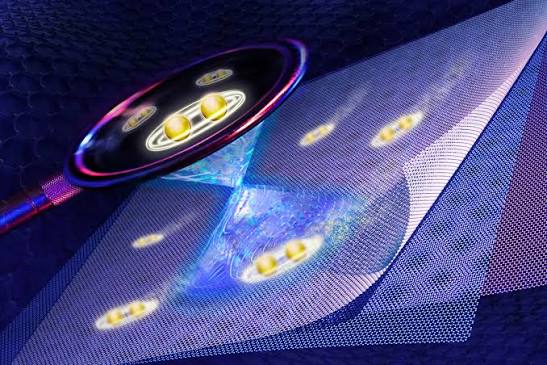

By stacking atomically thin materials at carefully chosen angles, physicists are learning to engineer superconductivity, magnetism, and topological states without changing the material itself.
Materials science traditionally begins with chemistry. If researchers want a material with different electrical, magnetic, or optical properties, they might change its chemical composition, introduce impurities, apply pressure, or synthesize an entirely new crystal. Over the past several years, however, physicists have developed another control knob that sounds almost too simple to be useful: rotation.
Take two sheets of an atomically thin material, place one on top of the other, and rotate one layer slightly. The atoms in the two sheets no longer line up perfectly. Instead, their overlapping crystal lattices create a much larger repeating interference pattern known as a moiré pattern. Similar patterns can appear when two meshes or grids are placed on top of each other at slightly different angles, but at the atomic scale the consequences are far more profound. The moiré pattern can reshape how electrons move, interact, and organize themselves across the material.
This field has become known as twistronics, because the electronic behavior of a device can be engineered through the relative twist between its layers. What began with remarkable experiments in graphene has expanded into semiconductors, magnetic materials, and topological systems. Instead of discovering quantum materials only by searching through the periodic table, researchers are increasingly learning how to assemble them.
Graphene provided the experiment that transformed twistronics from an interesting idea into a major research field. A single sheet of graphene is only one atom thick, with carbon atoms arranged in a honeycomb lattice. Two graphene sheets normally behave in relatively familiar ways when stacked together. But in 2018, researchers showed that twisting two layers to an angle close to 1.1 degrees dramatically changed the electronic behavior of the system.
Near this so-called magic angle, the electronic energy bands become unusually flat. Electrons that would normally move readily through the material slow down dramatically, allowing their mutual interactions to become much more important. The researchers observed correlated insulating behavior and superconductivity in closely related devices, demonstrating that a tiny geometrical adjustment could transform graphene into a laboratory for strongly interacting quantum matter. [1][2]
The importance of the discovery went beyond graphene itself. Scientists had effectively gained a new method for controlling the balance between an electron's tendency to move and its tendency to interact with other electrons. Many of the hardest problems in condensed-matter physics arise precisely when those two tendencies compete.
The effect can be understood by thinking about two nearly identical patterns placed on transparent sheets. When they are perfectly aligned, the pattern remains simple. Rotate one sheet slightly and a much larger pattern appears even though nothing about either individual sheet has changed.
At the atomic scale, that larger pattern becomes a new effective landscape for electrons. Different regions of the moiré cell correspond to slightly different atomic alignments, and electrons moving through the material experience a periodically changing environment much larger than the original crystal lattice.
The result is almost like building a new artificial crystal on top of the real one. Its basic repeating unit may span thousands of times more area than a single atomic unit cell, giving researchers a way to reshape electronic behavior without constructing a completely new chemical compound.
This is one of the defining ideas behind moiré materials: geometry itself becomes a materials-design tool.
The field has now moved far beyond the original magic-angle graphene experiment. Researchers have increasingly focused on atomically thin semiconductors known as transition-metal dichalcogenides, including materials such as WSe₂ and MoTe₂. These systems provide additional control over electronic interactions, spin, valley degrees of freedom, topology, and electric-field response.
Twisted WSe₂ has become particularly interesting because experiments have now observed robust superconductivity in the material. More recent work published in 2026 studied WSe₂ devices across a range of twist angles and found that the strongest superconductivity consistently appeared next to a Mott transition, where interactions are strong enough to drive electrons toward an insulating state. Researchers could tune the balance between electron motion and repulsion through both twist angle and electrical control. [3][4]
That level of tunability is unusually valuable. In many conventional superconductors, researchers receive whatever electronic structure nature provides and must try to infer why the material behaves as it does. Moiré systems offer the possibility of continuously changing important parameters inside essentially the same experimental platform.
Instead of comparing two entirely different crystals and wondering which microscopic difference matters, researchers can modify a twist angle or gate voltage and watch the quantum phase diagram evolve.
Superconductivity is only part of the story. Moiré materials have also become a remarkable platform for topological quantum matter, where the global structure of electronic quantum states produces behavior that cannot be understood only by looking locally at individual electrons.
Twisted MoTe₂ has produced some of the field's most striking results. Experiments have reported fractional quantum anomalous Hall states and related fractional Chern-insulator behavior, where strongly interacting electrons organize into a topological phase that resembles aspects of the fractional quantum Hall effect but can occur without the enormous external magnetic fields traditionally associated with that phenomenon. Later experiments also found evidence for a fractional quantum spin Hall state in twisted MoTe₂. [5][6]
These discoveries are important because fractional topological phases contain emergent excitations whose properties are not simply those of the original electrons. In some theoretical regimes, related systems could support unusual quasiparticles useful for studying topological quantum information. Researchers are still working out which phases are realized, how robust they are, and how competing states behave, but moiré materials have turned questions once associated mainly with idealized theoretical models into experimentally adjustable systems.
This ability to tune a material has led physicists to describe some moiré systems as quantum simulators for condensed matter. Many theoretical models simplify a complicated crystal into particles moving between sites on an idealized lattice and interacting with one another. Those models can be extremely difficult to solve when quantum correlations become strong.
Moiré materials can naturally produce large triangular or honeycomb-like electronic lattices whose interaction strengths and fillings can be adjusted experimentally. Rather than simulating such a model only inside a computer, researchers can create a physical material whose electrons approximately follow the model and then measure what happens.
That makes twistronics an unusual bridge between materials science and quantum simulation. The goal is not simply to find a substance with useful properties. Researchers can increasingly ask for a particular kind of quantum model and then engineer a layered structure that approaches it.
A crystal begins to resemble a programmable experimental platform.
Perhaps the most important feature of twistronics is the number of control knobs available simultaneously. Researchers can change the twist angle, vary the number of layers, choose different materials, alter electron density with electrical gates, apply displacement fields, or combine layers with different magnetic and topological properties.
Each choice can reshape the effective landscape experienced by the electrons.
This makes moiré engineering resemble a form of quantum architecture. A researcher is no longer limited to asking what properties a particular bulk crystal happens to possess. The more ambitious question is what combination of layers, angles, fields, and interactions will produce the desired many-body physics.
There are still serious challenges. Twist angles must often be controlled with extraordinary precision, microscopic strain and disorder can alter the result, and many of the most interesting phases occur only at extremely low temperatures. Even within nominally identical devices, small structural differences can influence the electronic states. The field is therefore far from having a simple recipe for manufacturing arbitrary quantum matter.
Yet progress since the first magic-angle experiments has been unusually rapid. By 2026, researchers are no longer studying one exceptional angle in one exceptional material. Experiments are mapping continuous ranges of twist angles, controlling competing magnetic and superconducting phases, and exploring increasingly exotic topological states across several families of two-dimensional materials.
The implications reach beyond any single proposed technology. Superconductivity remains one of the major unsolved problems in modern physics, particularly in materials where electron interactions play a central role. Topological phases could provide new routes for manipulating quantum information. Strongly correlated systems contain collective behavior that remains difficult to calculate even with today's largest computers.
Moiré materials offer a rare environment where all of these subjects can meet inside devices that researchers can deliberately modify.
The broader lesson is that discovering new states of matter may no longer require discovering entirely new substances. Sometimes the same atoms can produce radically different physics simply because their geometry has changed.
Twistronics turns a fraction of a degree into an experimental control knob, and that small rotation is giving physicists access to a rapidly expanding landscape of quantum matter.