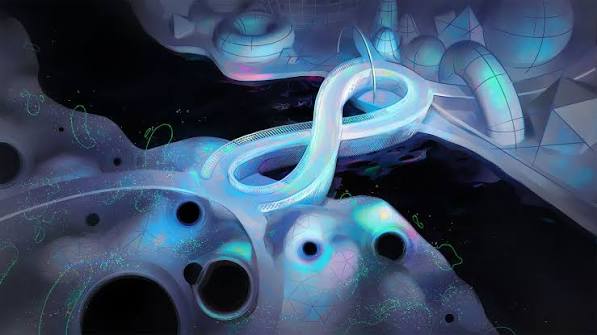

Quantum field theory allows a vacuum to be only temporarily stable. Its escape does not begin everywhere at once, but through a microscopic bubble created by quantum tunneling, a process that physicists can now imitate and watch inside programmable quantum systems.
The word vacuum sounds like it should describe nothing. In quantum field theory, it means almost the opposite. Every field permeating space has a configuration of lowest or locally lowest energy, and what we call empty space is the state of those fields when no ordinary particles are present. The vacuum therefore has structure. It can possess energy, respond to gravity, fluctuate quantum mechanically, and, under some circumstances, fail to be absolutely stable.
Imagine that the energy of a scalar field has two valleys. One valley lies higher than the other but is separated from it by an energy barrier. A classical system sitting at the bottom of the higher valley could remain there forever if it never received enough energy to climb over the barrier. A quantum field has another option. It can tunnel through the barrier. The higher minimum is then called a false vacuum, while the lower-energy configuration is called the true vacuum. Sidney Coleman developed the semiclassical theory of this process in 1977, showing that vacuum decay proceeds through the nucleation of bubbles containing the lower-energy phase. [1]
The unsettling part is that the transition does not require the entire universe to tunnel simultaneously. A sufficiently large bubble can appear locally. Inside the bubble, the field has crossed into the new vacuum. The bubble wall stores energy because the field must interpolate between two different configurations, but its interior gains energy because it occupies the lower-energy phase. Once the volume advantage becomes large enough to defeat the cost of the wall, the bubble expands.
This is one of the most dramatic predictions of quantum field theory, but it is also becoming a laboratory science. Experiments with atomic superfluids, Rydberg atoms, trapped ions, and thousands of superconducting qubits are beginning to reproduce the mathematics of metastability, tunneling, bubble nucleation, and bubble growth in controlled quantum systems. A 2024 experiment observed false-vacuum-like decay through bubble formation in a ferromagnetic superfluid. A 2025 quantum-annealer experiment followed quantized bubbles and their interactions using 5,564 superconducting flux qubits. In 2026, a Rydberg-atom experiment measured a decay law mirroring the exponential scaling predicted by field theory, while new two-dimensional simulations have begun studying the geometry and collisions of bubbles themselves. [5][6][7][10]
These experiments are analogues. They are not destabilizing the Higgs field, manufacturing a new cosmological vacuum, or putting the universe at risk. Their atoms and qubits obey engineered Hamiltonians whose mathematical structure reproduces selected aspects of false vacuum decay. What they offer is something that the actual early universe cannot provide: the ability to prepare the metastable state repeatedly, change its parameters, watch individual bubbles form, and test the nonperturbative physics in real time.
The simplest mathematical model begins with a scalar field $\phi$ and a potential energy density $V(\phi)$. Suppose the potential has a local minimum at $\phi_f$ and a deeper minimum at $\phi_t$:
$$ V(\phi_t)<V(\phi_f) $$
The field value $\phi_f$ represents the false vacuum and $\phi_t$ the true vacuum. The energy-density difference is
$$ \epsilon=V(\phi_f)-V(\phi_t)>0 $$
A classical particle placed at the false minimum cannot reach the lower minimum unless it receives enough energy to cross the barrier. A quantum field does not behave like one particle moving uniformly through this potential. Different spatial regions can fluctuate differently, so the field can tunnel by creating a localized region in which $\phi$ has moved toward the true vacuum while the surrounding space remains in the false vacuum. [1]
This distinction is essential. Vacuum decay is not ordinarily described as the entire field jumping from $\phi_f$ to $\phi_t$ everywhere at the same instant. It is a nucleation problem.
The newly created region has a boundary. Across this boundary, $\phi$ changes from one vacuum value to the other. Spatial gradients therefore contribute energy. If the wall has surface tension $\sigma$, a spherical true-vacuum bubble of radius $R$ has an approximate wall energy
$$ E_{\mathrm{wall}}=4\pi R^2\sigma $$
At the same time, converting the interior volume to the lower-energy vacuum produces an energy gain
$$ E_{\mathrm{volume}}=-\frac{4\pi}{3}R^3\epsilon $$
so the total energy is approximately
$$ E(R)=4\pi R^2\sigma-\frac{4\pi}{3}R^3\epsilon $$
The terms scale differently with radius. Surface cost grows as $R^2$, while volume gain grows as $R^3$. Small bubbles are dominated by their walls and tend to disappear. Large bubbles gain more energy by expanding than they pay in additional wall area.
The energy barrier reaches its maximum at
$$ R_{\mathrm{barrier}}=\frac{2\sigma}{\epsilon} $$
Classically, producing a bubble beyond that barrier would require supplying the appropriate energy. Quantum field theory instead allows the field configuration to tunnel.
Quantum tunneling in field theory is harder than tunneling through a barrier in introductory quantum mechanics because the tunneling object is not a single coordinate. It is an entire spatial field configuration,
$$ \phi(\mathbf{x}) $$
containing infinitely many degrees of freedom.
Coleman's solution was to reformulate the tunneling problem in Euclidean time. Ordinary time $t$ is analytically continued according to
$$ t=-i\tau $$
which converts the oscillatory quantum phase into an exponential weighting. The relevant tunneling configuration becomes a special solution of the Euclidean field equations called the bounce. [1]
For an approximately $O(4)$-symmetric bounce in four-dimensional spacetime, the field depends only on the Euclidean radial coordinate
$$ \rho=\sqrt{\tau^2+x^2+y^2+z^2} $$
and satisfies
$$ \frac{d^2\phi}{d\rho^2}+\frac{3}{\rho}\frac{d\phi}{d\rho}=\frac{dV}{d\phi} $$
with the field approaching the false vacuum far from the bounce.
The corresponding Euclidean action can be written as
$$ S_E=2\pi^2\int_0^\infty d\rho,\rho^3\left[\frac{1}{2}\left(\frac{d\phi}{d\rho}\right)^2+V(\phi)\right] $$
The quantity controlling the tunneling suppression is the difference between the bounce action and the action of the undisturbed false vacuum:
$$ B=S_E[\phi_{\mathrm{bounce}}]-S_E[\phi_f] $$
The vacuum decay rate per unit volume then has the characteristic semiclassical form
$$ \frac{\Gamma}{V}\approx A e^{-B/\hbar} $$
where $A$ is a prefactor arising from quantum fluctuations around the bounce. Coleman and Callan developed this semiclassical structure in the foundational false-vacuum calculations. [1][2]
This exponential is why metastable vacua can survive for extraordinary lengths of time. The vacuum may not be absolutely stable, yet if $B/\hbar$ is sufficiently large, the tunneling probability becomes unimaginably small.
A state can therefore be unstable in principle and effectively permanent on every familiar timescale.
In the thin-wall limit, where the two vacua are close in energy compared with the height of the barrier separating them, the bubble wall is much thinner than the bubble radius. The wall can then be characterized by a surface tension $\sigma$, and the Euclidean bounce becomes analytically transparent.
The tunneling bubble nucleates with radius
$$ R_b=\frac{3\sigma}{\epsilon} $$
and the semiclassical bounce exponent becomes
$$ B=\frac{27\pi^2\sigma^4}{2\epsilon^3} $$
These equations contain a powerful physical lesson. Increasing the wall tension makes vacuum decay dramatically harder because the exponent depends on $\sigma^4$. Increasing the energy difference between the vacua makes decay easier because the lower phase gains more energy by occupying the bubble volume.
The distinction between $R_b$ and the earlier static barrier radius $2\sigma/\epsilon$ is important. The static energy curve describes the energetic competition of spherical configurations at a fixed time. The quantum tunneling calculation takes place in four-dimensional Euclidean spacetime, and its bounce solution produces the radius $3\sigma/\epsilon$ in the thin-wall approximation. After analytic continuation back to real time, that Euclidean configuration becomes an expanding bubble.
The quantum event therefore looks almost impossible from the perspective of classical dynamics. The field does not slowly assemble a bubble by moving through a sequence of classically allowed intermediate configurations. The tunneling amplitude connects the metastable vacuum directly to a finite bubble configuration.
After nucleation, the problem changes character. The initial creation of the bubble is quantum mechanical, but sufficiently large bubbles can subsequently evolve approximately semiclassically. In the ideal relativistic thin-wall picture, a bubble nucleated at rest accelerates outward and its radius behaves schematically as
$$ R(t)=\sqrt{R_b^2+t^2} $$
when $c=1$.
Its wall velocity approaches the speed of light:
$$ \frac{dR}{dt}\rightarrow1 $$
as $t$ becomes large.
No material object has to be thrown outward from the center. Instead, the field at successive locations transitions from the false-vacuum configuration to the true-vacuum configuration as the wall passes. The bubble wall is a propagating field configuration.
If many bubbles nucleate, they eventually collide. Their walls can interact, merge, radiate excitations, and convert the remaining false-vacuum regions into the new phase. The details depend strongly on the underlying field theory. Bubble collisions are therefore relevant not only to vacuum stability but also to cosmological first-order phase transitions, where they may contribute to nonequilibrium particle production and gravitational-wave backgrounds.
The real-time quantum dynamics are difficult precisely because the process becomes highly nonperturbative. Numerical studies using tensor networks have simulated bubble-wall collisions in quantum spin chains, and recent work has pushed these ideas into genuinely two-dimensional systems where bubbles possess nontrivial shapes and interfaces rather than behaving as simple intervals. [4][10][11]
There is another way to understand why the process is so unusual. A false vacuum is not an excited particle sitting inside the vacuum. It is an excited state of the vacuum itself.
A particle excitation can often decay by emitting other particles:
$$ A\rightarrow B+C $$
Vacuum decay instead changes the state relative to which particles are defined. The masses, interactions, condensates, or symmetry structure experienced by excitations inside the new phase can differ from those outside it.
This is why vacuum decay appears throughout high-energy physics. Scalar fields can possess multiple minima after spontaneous symmetry breaking. First-order phase transitions in the early universe proceed through nucleation. Inflationary models may contain metastable states. Landscape models contain families of possible vacua. Even ordinary condensed-matter systems exhibit analogous metastability when one phase persists temporarily after another has become energetically favored.
The field-theory version is distinguished by quantum tunneling of an extended relativistic system.
The possibility becomes particularly famous when applied to the Higgs field.
At field values near the electroweak vacuum, the Higgs potential produces the familiar symmetry-breaking minimum associated with the measured Higgs vacuum expectation value. At much larger field values, however, quantum corrections modify the effective Higgs potential. A useful high-field approximation is
$$ V_{\mathrm{eff}}(h)\approx\frac{1}{4}\lambda_{\mathrm{eff}}(h)h^4 $$
where $h$ represents the Higgs field magnitude and $\lambda_{\mathrm{eff}}(h)$ is a scale-dependent effective quartic coupling.
The coupling evolves with energy through renormalization-group equations. Contributions involving the top-quark Yukawa coupling tend to drive the Higgs quartic downward, while other interactions contribute differently. For experimentally favored Standard Model parameters, many analyses place the electroweak vacuum intriguingly close to the boundary between absolute stability and metastability, although the quantitative conclusion depends sensitively on quantities including the top-quark mass, the strong coupling, matching procedures, and possible physics beyond the Standard Model. CERN reviews have emphasized this near-critical character. [12]
If $\lambda_{\mathrm{eff}}$ becomes negative at sufficiently large $h$, the familiar electroweak vacuum need not be the absolute minimum of the extrapolated Standard Model effective potential. That does not mean vacuum decay is expected soon. Standard analyses in the metastable region generally find lifetimes vastly longer than the present age of the universe for conventional central parameter choices. The question is instead scientifically fascinating because the measured Higgs and top parameters happen to place the Standard Model near a boundary where high-energy vacuum structure becomes sensitive to small changes and to new physics.
Gravity complicates the story further.
Vacuum energy gravitates. A bubble whose interior has a different vacuum energy changes the geometry of spacetime, so a fully cosmological tunneling calculation cannot always treat spacetime as a passive background. Coleman and Frank De Luccia extended vacuum-decay theory to include gravitational backreaction in 1980. Depending on the vacuum energies and wall tension, gravity can substantially modify the bounce and the tunneling rate and can even alter whether particular decay channels exist. [3]
The Euclidean action must then include gravity. Schematically,
$$ S_E=\int d^4x\sqrt{g}\left[-\frac{R}{16\pi G}+\frac{1}{2}(\nabla\phi)^2+V(\phi)\right] $$
where $R$ is the Ricci scalar and $g$ is the determinant of the Euclidean metric.
The field is no longer tunneling inside a fixed stage. The stage itself responds.
This is one reason vacuum decay connects particle physics to cosmology so naturally. A change in the vacuum energy changes not merely the internal state of a quantum field but the stress-energy sourcing spacetime curvature.
For most of the history of the subject, false vacuum decay was something physicists could calculate but not watch. The problem is inherently nonperturbative. Perturbation theory expands around small deviations from a known state, while tunneling connects field configurations separated by an energy barrier. Real-time simulation becomes even harder because a quantum field can develop large entanglement while bubbles nucleate, expand, and collide.
Quantum simulators offer a different strategy: build another quantum system governed by an engineered Hamiltonian that has a metastable state and a lower-energy competing phase.
A particularly simple example is the quantum Ising model,
$$ H=-J\sum_j Z_jZ_{j+1}-h_x\sum_j X_j-h_z\sum_j Z_j $$
Here $J$ favors neighboring spins pointing in the same direction, $h_x$ drives quantum transitions between spin configurations, and $h_z$ biases one polarization relative to the other.
When $h_z$ is chosen appropriately, one ferromagnetic state becomes the true ground state while the opposite polarization survives as a metastable state. A contiguous region of flipped spins then plays the role of a true-vacuum bubble. The domain walls at its boundaries cost energy, while the spins inside gain energy by aligning with the favored phase.
The mathematical analogy is immediate:
$$ \mathrm{domain\ wall\ energy}\leftrightarrow\mathrm{bubble\ surface\ tension} $$
and
$$ \mathrm{field\ bias}\leftrightarrow\mathrm{vacuum\ energy\ difference} $$
This does not make an Ising magnet a literal miniature universe. It makes the system a controllable quantum model of the same competition between interface energy, volume energy, metastability, and tunneling.
In 2024, Zenesini and collaborators experimentally observed false-vacuum-like decay using a ferromagnetic superfluid made from ultracold sodium atoms. Their system contained two coherently coupled internal atomic states whose interactions produced an effective asymmetric energy landscape. The experiment observed bubble formation and an exponential dependence of the nucleation timescale on parameters related to the energy barrier, with theory supporting an interpretation involving thermally activated false-vacuum decay. [5]
This result was important because bubble nucleation moved from being a theoretical picture into an experimentally observable dynamical process. The atoms were not simulating every degree of freedom of a relativistic cosmological field, but they reproduced the essential idea of a metastable collective state decaying through localized formation of the competing phase.
The next step was to look more closely at the bubbles themselves.
In 2025, a team used a programmable quantum annealer containing 5,564 superconducting flux qubits arranged to realize a large ferromagnetic Ising ring. By tuning the longitudinal field, they prepared a metastable polarized state and observed its decay into the favored state. Because the simulator was discrete, the bubbles appeared as domains containing integer numbers of flipped qubits, allowing the experiment to resolve quantized bubble sizes directly. [6]
The experiment went beyond merely seeing bubbles form. It investigated their interactions. Large bubbles in the regime studied could exchange spins with neighboring bubbles, while the smallest bubbles behaved as comparatively mobile objects. The authors described the dynamics as resembling a heterogeneous gas containing lighter and heavier bubbles. [6]
This matters because the traditional dilute-bubble picture often begins by treating nucleation events as largely independent. Once many bubbles exist at appreciable density, their interactions become part of the dynamics. The quantum simulator provided a controlled environment in which this next stage could be isolated and studied.
The experiment also demonstrates why analog quantum simulators are useful for quantum field theory even when they do not reproduce the target theory perfectly. The objective is often to isolate one difficult nonperturbative mechanism and build a system in which that mechanism becomes measurable.
Rydberg atoms provide another route because individual atoms can be trapped in optical tweezers, coherently controlled, and coupled through strong long-range interactions. In a 2026 Physical Review Letters experiment, Chao and collaborators used a ring of Rydberg atoms to study false-vacuum decay and bubble nucleation. They observed that the decay rate decreased exponentially with the inverse symmetry-breaking field, reproducing a characteristic scaling expected from field-theory descriptions of metastable decay. They also found that small imperfections in the prepared metastable state could strongly alter that scaling and studied resonant bubble nucleation associated with the discrete spectrum of the atomic system. [7]
The exponential scaling is especially significant because the hallmark of tunneling is not simply that a state eventually changes. Many ordinary relaxation mechanisms can do that. The field-theory prediction is that the decay rate carries an exponential dependence on an action or barrier-related quantity:
$$ \Gamma\propto e^{-B} $$
Recovering analogous exponential behavior in a programmable many-body experiment allows researchers to test the actual structure underlying metastable quantum decay rather than merely reproducing its final state.
The geometry becomes much richer in two spatial dimensions. In one-dimensional spin chains, a “bubble” is essentially an interval bounded by two domain walls. A two-dimensional bubble can curve, deform, roughen, collapse, and expand according to its perimeter and enclosed area. This begins to resemble the surface-versus-volume competition of continuum nucleation more directly.
A July 2026 tensor-network study investigated false vacuum decay in a two-dimensional quantum Ising system and extracted the decay rate, effective interface tension, and critical bubble size. The authors reported strong agreement between their quantum many-body simulations and semiclassical field-theory predictions, providing numerical evidence that the critical-bubble picture survives in an interacting $2+1$-dimensional quantum system. [8]
Another 2026 study used more than 4,000 qubits on a quantum annealer to explore a two-dimensional resonant regime in which seeded true-vacuum domains could grow nearly ballistically under local resonance conditions. [9]
Moving to higher dimensions is not merely a matter of making the simulator larger. Geometry itself becomes part of the physics.
An even stranger possibility is that vacuum decay need not always begin spontaneously.
In May 2026, Pavešić, Di Liberto, and Montangero reported tensor-network simulations of scattering in a two-dimensional quantum Ising model. After preparing the system in a metastable false vacuum, they collided energetic excitations and found a nonperturbative regime in which the collision could trigger a violent transition and launch an expanding true-vacuum bubble. [10]
The result concerns a quantum spin model, not the Standard Model vacuum, but conceptually it probes an old and difficult question: how does induced vacuum decay differ from spontaneous tunneling?
Spontaneous decay begins from quantum fluctuations of the metastable vacuum itself:
$$ \mathrm{false\ vacuum}\rightarrow\mathrm{bubble} $$
Induced decay instead has incoming excitations:
$$ \mathrm{particles}+\mathrm{false\ vacuum}\rightarrow\mathrm{bubble}+\cdots $$
This is much harder to describe semiclassically because scattering and tunneling occur together. It is precisely the kind of real-time strongly interacting process for which quantum simulation and tensor-network methods may become valuable.
Again, none of this means particle collisions in present accelerators threaten the cosmological vacuum. The simulated models are engineered many-body systems with tunable metastability. The scientific interest is in learning how nonperturbative vacuum transitions respond to localized energy and particle scattering.
The finite temperature version introduces another mechanism. At zero temperature, the system must tunnel through the barrier. At nonzero temperature, thermal fluctuations can help the field climb part or all of the way over it. For sufficiently high temperatures, the dominant semiclassical suppression is commonly written in terms of a three-dimensional Euclidean action:
$$ \frac{\Gamma}{V}\sim T^4 e^{-S_3/T} $$
where $S_3$ describes the critical thermal bubble.
This distinction matters for cosmology because the early universe was hot. A first-order transition can proceed by thermal nucleation long before zero-temperature tunneling would have become important. As the universe cools, bubbles of the new phase appear, expand, collide, and eventually complete the transition if the nucleation rate becomes sufficiently large.
The transition can therefore leave observable consequences even when the underlying fields are inaccessible directly. First-order phase transitions in the early universe are studied as possible sources of stochastic gravitational-wave backgrounds because rapidly evolving bubble walls and the surrounding plasma can generate large-scale stress-energy anisotropies.
False vacuum decay is thus not only a hypothetical end state of a metastable universe. The same mathematics may describe how the universe changed phases during its earliest moments.
The survival of a metastable vacuum is probabilistic. If bubbles nucleate approximately independently with rate $\Gamma$ per unit volume, then in a fixed spacetime volume one expects an exponential survival law of the rough form
$$ P_{\mathrm{survive}}(t)\sim e^{-\Gamma Vt} $$
for a simple homogeneous approximation.
This creates an important conceptual distinction between lifetime and scheduled decay. A radioactive nucleus with a one-hour half-life does not contain a clock telling it to decay after exactly one hour. Likewise, a metastable vacuum does not necessarily become progressively “worn out” as it ages. The decay is quantum probabilistic.
If the rate is extraordinarily tiny, the vacuum can survive for enormously longer than the current cosmic age while remaining technically metastable.
This is why headlines suggesting that vacuum metastability means the universe is about to disappear are misleading. Metastability alone says only that a lower-energy configuration may exist and that a tunneling process is allowed. The physically relevant question is the action $B$ and therefore the decay rate.
Because
$$ \Gamma\propto e^{-B/\hbar} $$
a modest change in $B$ can alter the lifetime by an enormous number of orders of magnitude.
There is another subtlety. A vacuum is not defined only by the shape of a classical potential. Quantum fluctuations modify that potential, and the result depends on scale.
The renormalization group expresses this through running couplings:
$$ \mu\frac{d\lambda}{d\mu}=\beta_\lambda $$
where $\lambda$ is a coupling, $\mu$ is the energy scale, and $\beta_\lambda$ is its beta function.
For the Higgs field, the effective potential at enormous field values is therefore influenced by physics measured at much lower energies. The measured Higgs mass, top-quark interactions, strong coupling, and any unknown particles coupled to the Higgs can alter the extrapolated high-energy landscape.
Vacuum stability becomes an extraordinary bridge across scales. Precision measurements of particles produced in accelerators can affect theoretical conclusions about whether the quantum state of empty space remains the lowest-energy state all the way toward vastly higher field values. Current research continues to investigate how extensions of the Standard Model can shift the metastability boundary or produce new vacuum structures.
The most important experimental development may not be any individual simulator but the fact that several very different platforms are converging on the same problem. Ferromagnetic superfluids provide continuous collective fields. Rydberg arrays provide individual-site control and long-range interactions. Trapped ions can implement tunable Ising-like interactions and directly image bubble formation across driven first-order transitions. Quantum annealers provide thousands of interacting qubits, large enough to study bubble gases and two-dimensional domain growth. Tensor networks supply complementary classical simulations capable of accessing regimes where experiments are not yet available.
Each platform distorts the original field-theory problem in a different way. Lattices discretize space. Finite systems have boundaries. Real hardware has noise and dissipation. Spin models contain discrete degrees of freedom rather than continuous relativistic scalar fields. Some experiments study thermal activation, some coherent quantum tunneling, and others resonant many-body dynamics.
Those differences are not merely imperfections. They allow physicists to ask which aspects of vacuum decay are universal and which depend on the microscopic theory.
Does the exponential tunneling law survive?
Does the critical-bubble picture survive?
How do bubbles interact after nucleation?
What changes in two spatial dimensions?
Can scattering trigger a transition?
How does dissipation change the decay?
At what point does a semiclassical bubble stop being an adequate description and the full many-body quantum state become essential?
False vacuum decay is becoming a test case for whether quantum simulators can attack exactly the kinds of real-time nonperturbative problems that are hardest for conventional field-theory calculations.
This may ultimately be the most interesting part of the subject. Quantum simulation is not being used merely because the words “quantum” and “vacuum” happen to appear together. It addresses a fundamental computational mismatch.
Quantum field theory is extremely successful when interactions can be handled perturbatively or when equilibrium quantities can be computed through Euclidean methods. Vacuum decay, bubble growth, and bubble collisions are inherently real-time, strongly nonequilibrium phenomena. A fully quantum calculation must keep track of superpositions of different bubble configurations, entanglement between spatial regions, particle production, and interactions among domain walls.
The quantum state can schematically become
$$ |\Psi(t)\rangle=c_0(t)|\mathrm{false}\rangle+\sum_B c_B(t)|B\rangle+\sum_{B_1,B_2}c_{B_1B_2}(t)|B_1,B_2\rangle+\cdots $$
where the amplitudes represent the false vacuum, one-bubble states, multiple-bubble configurations, and increasingly complicated excitations.
The familiar semiclassical picture selects a dominant bounce and then follows an approximately classical bubble. The exact quantum state can contain far more structure.
The 2025 quantum-annealer results already suggest that interactions among quantized bubbles can become essential beyond the earliest nucleation stage, while 2026 two-dimensional work is beginning to test how much of the continuum critical-bubble picture survives in genuinely interacting lattice systems. [6][8]
Vacuum decay also changes how we think about “nothing.”
In classical mechanics, the empty background usually plays no dynamical role. Objects move through space, fields occupy space, and the stage remains conceptually distinct from what happens upon it.
Quantum field theory removes that separation. What appears empty is itself a quantum state. It has correlation functions, zero-point fluctuations, condensates, symmetries, and an energy structure. The identity of elementary particles depends on that background state. The Higgs vacuum, for example, is directly connected to how particles acquire mass through their coupling to the Higgs field.
A transition between vacua is therefore not like changing one object inside the universe.
It changes part of the definition of the universe's physical state.
This is why the subject sits at the intersection of some of the deepest areas of modern physics: quantum tunneling, spontaneous symmetry breaking, renormalization, cosmological phase transitions, gravitational instantons, Higgs physics, nonequilibrium many-body dynamics, and quantum simulation.
The popular version of false vacuum decay usually ends with the most dramatic possibility: if our universe occupied a metastable vacuum and a lower vacuum bubble nucleated somewhere, a sufficiently favorable bubble could expand outward and transform the surrounding field configuration.
The scientifically interesting story begins before that sentence.
How does a field containing infinitely many degrees of freedom tunnel?
Why does the dominant process take the form of a bubble?
Why is the tunneling rate controlled by a Euclidean solution?
Why does surface tension compete with vacuum energy?
How does gravity alter the instanton?
When does quantum nucleation turn into semiclassical expansion?
What happens when two bubbles collide?
And can a programmable many-body quantum system reproduce the same scaling laws?
For almost fifty years, these questions were dominated by semiclassical equations and numerical theory. They are now entering a period in which some of the underlying dynamics can be engineered experimentally. Quantum simulators have already observed bubble formation, quantized bubble sizes, interactions between bubbles, and field-theory-like exponential decay laws. Two-dimensional simulations are now reaching the point where the actual geometry of the bubble becomes a dynamical object.
The vacuum may be the state we call empty space, but false vacuum decay demonstrates that emptiness can possess a landscape, a lifetime, and a tunneling amplitude.
And in modern laboratories, physicists are beginning to watch an analogue of that emptiness break apart one quantum bubble at a time.