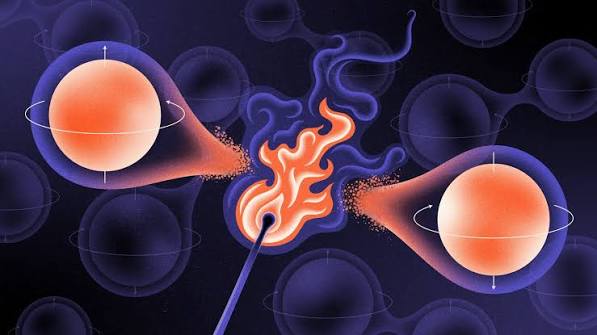

The quantum Mpemba effect reveals that distance from equilibrium does not determine how quickly a system returns to it. Sometimes the state that begins farther away gets there first.
If two identical systems are placed in the same environment, intuition suggests that the one initially closer to equilibrium should reach equilibrium first. A warmer object should take longer to cool than a cooler one. A state that is badly disturbed should require more time to relax than one that is already almost settled. This expectation is so natural that it is easy to mistake it for a law.
The most famous counterexample is the Mpemba effect, named after Erasto Mpemba, who with Denis Osborne published experiments in 1969 describing conditions under which initially hotter water could begin freezing sooner than colder water. The precise behavior of water depends sensitively on experimental conditions, and the historical water problem should not be confused with a universal rule that hot water always freezes first. The broader physics that grew from it is much more general: a system initially farther from equilibrium can sometimes relax faster than one that begins closer to equilibrium. [1]
Quantum mechanics turns this curiosity into something deeper. In a quantum system, relaxation does not occur along a single one-dimensional path labeled only by temperature. A density matrix can contain populations, coherence, entanglement, conserved charges, broken symmetries, and correlations with an environment. Two states can therefore be ordered one way according to energy and an entirely different way according to the dynamical modes controlling their return to equilibrium.
This creates the quantum Mpemba effect. A quantum state can begin farther from its final state and still arrive sooner because it couples only weakly, or sometimes not at all, to the slowest mode of relaxation. In the strongest version, that slow mode can be eliminated completely from the initial state, changing the asymptotic relaxation rate itself rather than merely giving one state a temporary head start. Theoretical work established this possibility in Markovian open quantum systems, and experiments have since observed quantum Mpemba behavior in trapped ions and superconducting processors. [2][3][6][9]
The surprising lesson is that being closer to equilibrium is not the same thing as being dynamically better positioned to reach it.
The ordinary intuition comes from exponential relaxation. If a single quantity $x(t)$ approaches equilibrium through one decay rate $\gamma$, then
$$ x(t)-x_{\mathrm{eq}}=[x(0)-x_{\mathrm{eq}}]e^{-\gamma t} $$
Two initial states following the same equation preserve their ordering. If one begins twice as far from equilibrium, it remains twice as far away at every later time. There is no possibility of an Mpemba crossing.
Real many-body and quantum systems generally possess many relaxation modes.
Even a classical Markov process may evolve through a hierarchy of exponentially decaying modes. An open quantum system makes this structure especially explicit because its density matrix evolves under a superoperator rather than a single scalar decay constant. For Markovian dynamics, the evolution is often written in Lindblad form,
$$ \frac{d\rho}{dt}=-i[H,\rho]+\sum_k\gamma_k\left(L_k\rho L_k^\dagger-\frac{1}{2}{L_k^\dagger L_k,\rho}\right) $$
where $H$ generates coherent evolution, $L_k$ describe dissipative processes, and $\gamma_k$ are their rates.
This equation can be abbreviated as
$$ \frac{d\rho}{dt}=\mathcal{L}(\rho) $$
where $\mathcal{L}$ is the Liouvillian.
The Liouvillian plays a role for relaxation somewhat analogous to the role played by the Hamiltonian for coherent dynamics. Its eigenmodes satisfy
$$ \mathcal{L}(R_j)=\lambda_jR_j $$
where $R_j$ is a relaxation mode and $\lambda_j$ is generally complex. The steady state has eigenvalue
$$ \lambda_0=0 $$
while stable decaying modes satisfy
$$ \mathrm{Re}(\lambda_j)<0 $$
The real part determines how quickly a mode disappears. A mode with an eigenvalue close to zero decays slowly, while a mode whose real part is strongly negative dies away much faster. This spectral viewpoint is central to modern explanations of the strong quantum Mpemba effect. [2][6]
For a diagonalizable Liouvillian, the time-dependent state can be expressed schematically as
$$ \rho(t)=\rho_{\mathrm{ss}}+\sum_{j\geq1}c_je^{\lambda_jt}R_j $$
where $\rho_{\mathrm{ss}}$ is the stationary state and the coefficients $c_j$ depend on the initial condition.
Suppose the eigenvalues are ordered so that
$$ 0>\mathrm{Re}(\lambda_1)>\mathrm{Re}(\lambda_2)>\mathrm{Re}(\lambda_3)>\cdots $$
Then $\lambda_1$ describes the slowest nonstationary mode.
At sufficiently long times, almost every faster contribution has vanished and the state behaves approximately as
$$ \rho(t)-\rho_{\mathrm{ss}}\approx c_1e^{\lambda_1t}R_1 $$
The important quantity is therefore not only the distance of the initial state from equilibrium. It is the coefficient $c_1$.
Imagine two states. State $A$ begins relatively close to equilibrium but has a large overlap with $R_1$. State $B$ begins much farther away but has very little overlap with $R_1$. State $B$ initially has more relaxing to do, but most of its deviation lies in faster modes. Those modes disappear quickly. Eventually $B$ overtakes $A$.
That is the spectral anatomy of a Mpemba effect.
The most dramatic case occurs when the initial state can be engineered so that
$$ c_1=0 $$
The slowest decay channel is then absent altogether. At long times the state is controlled by the next mode,
$$ \rho(t)-\rho_{\mathrm{ss}}\approx c_2e^{\lambda_2t}R_2 $$
Because $\mathrm{Re}(\lambda_2)$ is more negative than $\mathrm{Re}(\lambda_1)$, the asymptotic decay itself becomes faster. This is called a strong Mpemba effect. Carollo, Lasanta, and Lesanovsky showed theoretically that such an exponentially accelerated approach to stationarity can occur in Markovian open quantum systems. [2]
The paradox therefore disappears once relaxation is viewed as multidimensional. The farther state does not somehow move faster along the same road.
It takes a road that avoids the traffic.
This also explains why “hotter” can be a misleading word in quantum Mpemba physics. Temperature is well defined for an equilibrium thermal state,
$$ \rho_T=\frac{e^{-H/k_BT}}{Z} $$
where
$$ Z=\mathrm{Tr}(e^{-H/k_BT}) $$
is the partition function. But many experiments investigating quantum Mpemba effects deliberately prepare states that are not thermal equilibrium states at all. Their relevant distance from equilibrium may involve coherence, symmetry breaking, subsystem density matrices, or quantum information measures.
A useful abstract formulation is therefore:
State $A$ starts farther from $\rho_{\mathrm{ss}}$ than state $B$, but at some later time
$$ D_A(t)<D_B(t) $$
where $D$ is a chosen measure of distance from the stationary state.
The trajectories have crossed.
This broader formulation allows Mpemba behavior to appear in situations where the language of literal cooling is no longer appropriate. An isolated quantum many-body system can exhibit Mpemba-like symmetry restoration. A quantum battery can display anomalously fast loss of extractable work. A qubit can exhibit the inverse effect while heating. Open systems with environmental memory can relax anomalously. The common structure is not temperature itself but the dependence of relaxation on the initial state's projection onto dynamical modes. [3][4][5][7]
One of the most compelling demonstrations came from a trapped-ion quantum simulator in 2024. Researchers prepared a many-body spin system in different tilted ferromagnetic states and watched an initially broken spin-rotational symmetry return during quantum evolution. Counterintuitively, the state prepared with greater initial symmetry breaking could restore symmetry faster than a state that started closer to being symmetric. The experiment provided the first experimental evidence for this form of the quantum Mpemba effect in a quantum simulator. [3]
This is not cooling in the everyday sense.
Imagine spins initially aligned along a direction that does not respect the symmetry of the Hamiltonian. The system evolves, quantum correlations spread, and local subsystems gradually lose information about that preferred direction. At late times, the reduced state can become effectively symmetric even though the global system evolves unitarily.
The experiment monitored this process using entanglement asymmetry, a quantity designed to measure how strongly a subsystem violates a symmetry. It was extracted through randomized measurements and classical-shadow postprocessing, with subsystem thermalization also tested by comparing experimental reduced density matrices to the expected stationary symmetric state. [3]
A schematic definition can be written as
$$ \Delta S_A=S(\rho_{A,Q})-S(\rho_A) $$
where $\rho_A$ is the reduced density matrix of subsystem $A$, while $\rho_{A,Q}$ is its symmetry-resolved or charge-dephased counterpart. When the subsystem fully respects the relevant symmetry,
$$ \Delta S_A=0 $$
The experimentally surprising behavior is that a state with larger initial $\Delta S_A$ can sometimes reach zero faster than one with smaller initial asymmetry.
The farther state restores symmetry first.
The many-body effect becomes especially interesting because there is no external cold bath doing the relaxing. The full state can undergo unitary evolution,
$$ |\psi(t)\rangle=e^{-iHt}|\psi(0)\rangle $$
while a finite subsystem approaches an effectively thermal or symmetry-restored state because information spreads into correlations with the rest of the system.
This separates two ideas that are often casually merged. A closed quantum system preserves its global information under unitary evolution, yet small pieces of that system can still lose access to their initial local structure. Thermalization is then produced by entanglement and information redistribution, not by information literally disappearing.
A 2026 theoretical study of long-range spin systems investigated the mechanism behind this version of the Mpemba effect and found that quantum fluctuations of the magnetization can drive symmetry restoration by melting the initial ferromagnetic order. The effect was found across a broad parameter regime for long-range interactions, helping explain why ion-trap systems provide a natural setting for the phenomenon. [8]
The quantum Mpemba effect can therefore appear in two conceptually different regimes. In an open system, it may arise because the initial state avoids slow Liouvillian decay modes. In an isolated many-body system, it may arise through the structure of entanglement growth, quasiparticle propagation, symmetry restoration, or integrable dynamics.
The phrase names a pattern of anomalous relaxation rather than one single microscopic mechanism.
A second 2024 trapped-ion experiment revealed an even cleaner quantum version: the inverse Mpemba effect.
Instead of asking whether a hotter system can cool faster, researchers asked whether a colder quantum system can heat faster than one initially closer to the hot equilibrium state. Using a single trapped $^{88}\mathrm{Sr}^{+}$ ion as a qubit, they demonstrated precisely this behavior. In the strong regime, the colder initial state approached the high-temperature state exponentially faster. Crucially, the authors found that sufficient quantum coherence was required, so the observed effect depended on interference and was genuinely quantum in their implementation. [4]
Coherence provides degrees of freedom unavailable to an ordinary classical thermal population.
A qubit density matrix can be written schematically as
$$ \rho=\frac{1}{2}(I+\mathbf{r}\cdot\boldsymbol{\sigma}) $$
where $\mathbf{r}$ is the Bloch vector. Its orientation contains information not captured by energy alone. Two states with similar populations can possess different transverse coherence, placing them on different trajectories toward the same stationary state.
Relaxation is therefore geometric.
The initial state is not described by a point on a temperature line but by a point inside the Bloch sphere. The environment defines a vector field telling every state how to move. Two states that look naturally ordered according to temperature can occupy very different streamlines.
The inverse quantum Mpemba effect is then not a violation of thermodynamics. It is evidence that thermodynamic distance and dynamical direction are different objects.
The strongest experimental version arrived in work published in Nature Communications in 2025. Researchers prepared a single trapped ion in a specially designed pure quantum state with zero overlap with the slowest decaying mode. They observed an exponential acceleration of relaxation compared with more ordinary initial states. [6]
The result is a direct realization of the spectral argument.
If
$$ c_1=0 $$
then the slowest mode does not participate. The state may begin farther from stationarity, but its long-time decay is controlled by $\lambda_2$ rather than $\lambda_1$.
Suppose
$$ |\mathrm{Re}(\lambda_2)|\gg|\mathrm{Re}(\lambda_1)| $$
Then the difference in relaxation time can become enormous. The strong Mpemba state is not merely winning a race by a small margin. It has removed the process responsible for the longest tail of the relaxation.
The experiment achieved this through initial-state engineering. A unitary operation rotated the ion into an optimal state that suppressed its overlap with the slowest-decaying Liouvillian eigenmode. The observed behavior turns the Mpemba effect from a passive curiosity into a control principle: if the slow modes of a dissipative quantum device are understood, one can attempt to prepare states that do not excite them. [6]
This flips the normal engineering intuition.
Instead of modifying the environment to make relaxation faster, modify the initial quantum state so that the environment has less slow work to do.
The same experiment revealed an unexpected connection to non-Hermitian physics.
Although the density matrix itself remains physical, the Liouvillian governing dissipative dynamics is generally not Hermitian. Its eigenvalues can be complex, its left and right eigenvectors need not coincide, and its spectrum can contain exceptional points where both eigenvalues and eigenvectors coalesce.
For a simple two-mode non-Hermitian problem, one may write eigenvalues schematically as
$$ \lambda_{\pm}=\frac{\lambda_a+\lambda_b}{2}\pm\sqrt{\left(\frac{\lambda_a-\lambda_b}{2}\right)^2+g^2} $$
An exceptional point occurs when the expression inside the square root vanishes:
$$ \left(\frac{\lambda_a-\lambda_b}{2}\right)^2+g^2=0 $$
At this point, the two eigenvalues merge and the associated eigenvectors cease to remain independent.
The 2025 strong-Mpemba trapped-ion experiment found that the parameter region allowing its optimal strong effect was connected to a Liouvillian exceptional point. The authors experimentally linked exponentially accelerated relaxation with the coalescence structure of the Liouvillian modes. [6]
This creates a remarkable bridge between two seemingly separate subjects. The Mpemba effect concerns anomalous thermodynamic relaxation. Exceptional points belong to non-Hermitian spectral theory. Both turn out to depend on the geometry and accessibility of decay modes.
A phenomenon that began with cooling water has arrived at the spectral singularities of open quantum mechanics.
Exceptional points are not, however, a universal requirement for every quantum Mpemba effect. Different systems exhibit anomalous relaxation for different reasons. What exceptional points provide is one especially powerful route for reorganizing the slow-mode structure.
This distinction has become clearer as the field has expanded.
In 2025, researchers developed a general non-Markovian quantum Mpemba effect in which environmental memory changes the relaxation problem itself. Their theory showed that open quantum systems with finite memory can exhibit Mpemba behavior unavailable in ordinary memoryless dynamics, including initial states capable of reaching the stationary state within the environment's memory timescale. They demonstrated the mechanism in quantum-dot models coupled to electronic reservoirs. [7]
Markovian evolution assumes, roughly speaking, that the environment has no useful memory of the system's previous history. A simplified dynamical law can then depend only on the current state:
$$ \frac{d\rho(t)}{dt}=\mathcal{L}(\rho(t)) $$
A non-Markovian system can instead have dynamics influenced by earlier times. Schematically,
$$ \frac{d\rho(t)}{dt}=\int_0^tK(t-s)\rho(s),ds $$
where $K(t-s)$ is a memory kernel.
Information can temporarily flow into the environment and later influence the system again. The bath is no longer simply a sink.
In that regime, deciding which initial state relaxes fastest becomes more complicated because the environment's memory and the initial state can interact. The fastest path to equilibrium can exploit the history dependence rather than merely avoiding one fixed Liouvillian eigenmode. [7]
Work published in Physical Review Letters in 2026 extended this connection still further by proposing a mechanism in which non-Markovian exceptional points generate quantum Mpemba behavior. The study used an exactly solvable dissipative quantum harmonic oscillator to show how exceptional spectral structures can survive beyond the standard Born-Markovian approximation. [11]
That is important because Liouvillian eigenmode arguments are especially clean when relaxation can be described by a time-independent Markov generator. Real quantum devices often have structured environments, strong coupling, finite correlation times, and memory effects. Extending Mpemba physics into those regimes suggests that anomalous relaxation is not a fragile consequence of one idealized master equation.
The deeper question is becoming:
Can the spectrum and memory of the environment be engineered together to control the route to equilibrium?
If so, “relaxation” stops being something that engineers merely tolerate. It becomes a resource that can be designed.
Noise adds another twist.
Noise is usually treated as the enemy of quantum control because it destroys coherence and introduces unwanted fluctuations. A 2026 Communications Physics study showed theoretically that external random telegraph noise can either induce or eliminate a quantum Mpemba effect depending on how the initial states overlap with noise-generated slow modes. The same analysis found parameter regimes in which the noise reshapes relaxation in ways that can delay decoherence for selected states. [10]
The mechanism is spectral. Adding correlated noise enlarges the effective dynamical structure and introduces additional modes. Some of those modes can decay more slowly than the modes of the clean system. Whether a particular initial state excites them determines its eventual relaxation.
Noise can therefore change the ranking of states.
A state that was previously fast may acquire overlap with a new slow mode and become slow. Another state may avoid that same mode and suddenly display a Mpemba crossing.
This does not mean that arbitrary noise improves a quantum computer. It means that noise has structure, and structured fluctuations can reshape the dynamical spectrum in predictable ways.
The most interesting control parameter may sometimes be the imperfection itself.
The many-body story also accelerated in 2026. A superconducting quantum processor was used to observe and deliberately modulate the quantum Mpemba effect across different interaction regimes. The processor offered tunable coupling geometry, allowing the researchers to vary interactions, on-site potentials, and initial states while monitoring symmetry restoration through entanglement asymmetry reconstructed using quantum state tomography. [9]
The effect did not simply appear everywhere. Under strong short-range coupling, the experiment observed the expected Mpemba crossovers for tilted Néel states. In an intermediate coupling regime, the effect was suppressed. It could then be restored by modifying on-site potentials or by changing the family of initial states. [9]
This is a major conceptual progression.
The question is no longer only
“Does a quantum Mpemba effect exist?”
It is becoming
“Can we switch it on and off?”
The superconducting experiment shows that anomalous relaxation is sensitive to interaction structure and initial-state preparation in a controllable many-body platform. [9]
In other words, the Mpemba effect is becoming programmable.
Another 2026 theoretical result found an especially elegant mechanism in long-range XXZ spin chains. At a symmetry-enhanced point, the Liouvillian spectrum can organize into a regularly spaced relaxation comb. Symmetry determines which teeth of that comb an initial state can access. For specially structured states, the slowest nonsteady modes become inaccessible, producing a strong quantum Mpemba effect through a type of spectral filtering. [12]
This provides a useful way to think about the phenomenon.
Suppose a system contains decay rates
$$ \lambda_q=-2q $$
for integer mode labels $q$ in an appropriate dimensionless description. If symmetry prevents an initial state from coupling to the slowest available sectors, the state can immediately relax through modes farther down the comb.
The Hamiltonian has not necessarily been made more dissipative.
The state has simply been denied access to the slow road.
This emphasizes that conserved quantities and symmetries can act like selection rules for relaxation, much as quantum selection rules determine which atomic transitions are allowed.
The same principle may eventually be useful technologically because quantum hardware constantly performs tasks that are really relaxation problems.
A qubit must be reset before reuse. A dissipative state-preparation protocol must converge toward a desired state. A quantum sensor interacts with an environment before measurement. A quantum battery can lose useful work through relaxation. Quantum simulators need controlled equilibration. In all these cases, the relevant practical question is not merely the equilibrium state but how quickly it is reached from a chosen initial condition.
Quantum batteries provide a particularly vivid example. In 2025, researchers introduced an ergotropic Mpemba effect in which states containing more extractable quantum work can discharge faster than states containing less. The relevant resource is ergotropy rather than temperature, demonstrating again that Mpemba physics is fundamentally about anomalous relaxation ordering rather than literal heating and cooling. [13]
Similarly, recent work has explored Mpemba-inspired strategies for accelerated qubit reset and state preparation. The useful lesson is not that quantum computers should be made hotter before every operation. It is that carefully prepared nonequilibrium states may relax toward a desired target faster than apparently more convenient starting states.
Quantum thermometry offers another surprising application. A thermometer works because a probe interacts with an environment whose temperature is unknown. Eventually the probe approaches thermal equilibrium, but waiting for full equilibration can be slow. If useful temperature information is available during the transient regime, an optimal probe might deliberately begin far from equilibrium.
A 2026 theoretical study established a connection between quantum Mpemba behavior and nonequilibrium quantum thermometry. In the Markovian model considered, initial states optimized for early-time temperature estimation were found with high probability to display Mpemba-type accelerated thermalization compared with typical initial states. [14]
The result suggests that fast relaxation does not necessarily destroy sensing usefulness. Under appropriate conditions, the states that move unusually efficiently through state space may also acquire temperature information rapidly.
This gives the Mpemba effect an information-theoretic interpretation.
A relaxation path is not only transporting energy.
It is transporting information about the environment into the quantum state.
There is yet another reason the phenomenon is becoming interesting: relaxation can be nonreciprocal.
In a July 2026 preprint, researchers considered open quantum systems coupled symmetrically to two reservoirs. Swapping the reservoir parameters could turn the quantum Mpemba effect on or off even while leaving the Liouvillian eigenvalues unchanged. What changed were the eigenvectors and therefore the projections of the initial states onto the slow modes. [15]
This is subtle.
If the spectrum remains identical,
$$ {\lambda_j}{\mathrm{before}}={\lambda_j}{\mathrm{after}} $$
one might expect the overall relaxation behavior to remain essentially the same.
But eigenvalues tell only part of the story.
The coefficients
$$ c_j $$
also depend on the eigenvectors. Rotating the eigenvectors changes which initial states excite which decay channels. The 2026 proposal therefore demonstrates a Mpemba mechanism carried entirely by mode geometry rather than decay-rate spectrum. [15]
This reinforces a central message running through the whole subject:
Knowing the relaxation timescales is not enough.
One must also know how the state sits inside the relaxation eigenbasis.
The thermodynamics of all this requires care. A faster-relaxing state does not automatically violate the second law, generate free work, or reverse the arrow of time.
The second law constrains thermodynamic quantities under specified processes. It does not say that every measure of distance from equilibrium must decrease at a rate monotonically ordered by initial temperature.
For a system coupled to a thermal bath, one useful quantity is the nonequilibrium free energy,
$$ F(\rho)=E(\rho)-TS(\rho) $$
where
$$ E(\rho)=\mathrm{Tr}(H\rho) $$
and
$$ S(\rho)=-\mathrm{Tr}(\rho\ln\rho) $$
is the von Neumann entropy.
A state farther from equilibrium can initially contain more free energy while still losing that excess more rapidly. Research on the thermodynamics of the quantum Mpemba effect has investigated precisely how anomalous relaxation can coexist with the normal constraints of irreversible thermodynamics. [5]
The effect does not permit the system to arrive at an impossible final state.
It changes the route and timescale by which an allowed final state is reached.
That is why the phenomenon is compatible with thermodynamics while still violating a common intuition derived from oversimplified one-mode relaxation.
The distinction between a weak and strong Mpemba effect is particularly important here.
In a weak Mpemba effect, both states may eventually be governed by the same slowest eigenvalue. The farther state simply has a smaller coefficient:
$$ |c_1^{(F)}|<|c_1^{(N)}| $$
where $F$ denotes the farther state and $N$ the nearer state.
The two trajectories cross, but asymptotically both decay with the same exponential rate.
In the strong effect,
$$ c_1^{(F)}=0 $$
The farther state's slowest populated mode is different, so the relaxation exponent itself changes.
This distinction determines how valuable the effect could become technologically. A small prefactor advantage may save a finite amount of time. Removing an entire slow eigenmode can produce a speedup that becomes increasingly dramatic when the spectral gap between slow and fast modes is large. [2][6]
If a quantum device contains one exceptionally long-lived unwanted mode, eliminating its initial excitation could be far more effective than modestly increasing every dissipation rate.
The geometry of state space helps unify all of these examples.
Consider the stationary state $\rho_{\mathrm{ss}}$ as a destination inside the space of density matrices. A naïve picture would assign every state a distance $D(\rho,\rho_{\mathrm{ss}})$ and assume that smaller distance means shorter travel time.
But the dynamics define a vector field over that space:
$$ \dot{\rho}=\mathcal{L}(\rho) $$
The vector can point in very different directions at different locations.
A nearby state may sit almost parallel to a slow manifold and crawl toward the destination. A more distant state can begin in a direction aligned with a rapidly contracting manifold and move inward much faster.
Distance is geometric.
Relaxation time is dynamical.
There is no theorem requiring the two orderings to coincide.
Seen this way, the Mpemba effect is less a paradox than a warning against reducing multidimensional dynamics to a single scalar notion of “how far away” a system is.
This viewpoint also connects anomalous relaxation to ideas that appear elsewhere in quantum science. Decoherence-free subspaces exploit states that avoid particular environmental couplings. Dark states avoid optical transitions through destructive interference. Quantum error-correcting codes encode information in degrees of freedom insensitive to certain errors. Adiabatic shortcuts engineer trajectories that avoid slow evolution.
The strong quantum Mpemba effect has a related flavor.
Instead of protecting a state from decay, it deliberately places the state where an undesired slow decay mode cannot be excited.
The optimization target is reversed.
A dark state tries not to relax.
A strong Mpemba state tries to relax as efficiently as possible.
That conceptual reversal makes the effect especially interesting for quantum control.
The field is still young enough that there is no single universal theory explaining every quantum Mpemba effect. Some examples arise from Liouvillian eigenmode overlaps. Others involve quantum coherence, many-body symmetry restoration, quasiparticles, integrability, environmental memory, non-Hermitian exceptional points, noise-induced modes, or symmetry-imposed selection rules. Recent reviews and experiments increasingly treat these as a family of related nonequilibrium phenomena rather than manifestations of one microscopic process.
That diversity is scientifically useful because it transforms the original paradox into a broader research program.
Which states relax fastest?
Which observables display crossings?
Can strong Mpemba states always be constructed?
How much information about the Liouvillian is required to find them?
What survives in large interacting systems?
Can the effect scale favorably with system size?
Can noise be engineered to create rather than destroy the effect?
Can the phenomenon accelerate useful quantum resets, thermalization protocols, sensors, or dissipative state preparation?
These are no longer questions about whether hot water freezes first. They concern the geometry of nonequilibrium quantum dynamics.

The most striking lesson may be that equilibrium contains very little information about how equilibrium will be reached.
Two states can share the same final thermal state and obey the same microscopic equations while taking radically different routes toward it. Their energies can suggest one ranking, their geometric distances another, and their relaxation-mode overlaps a third. The late-time behavior can ultimately be determined by a coefficient that is invisible if one looks only at how far each state begins from equilibrium.
In the simplest spectral language,
$$ \rho(t)=\rho_{\mathrm{ss}}+\sum_jc_je^{\lambda_jt}R_j $$
contains the entire idea.
The eigenvalues $\lambda_j$ tell us which roads are slow.
The coefficients $c_j$ tell us which roads the initial state actually takes.
A system that begins farther away can arrive first because distance is not destiny.
Modern quantum experiments are now going one step further. They are not merely observing anomalous relaxation after it happens. Trapped ions have been prepared in states designed to remove slow decay modes. Superconducting processors have switched many-body Mpemba behavior on and off by tuning interactions and initial states. Current theory is exploring environmental memory, noise-generated relaxation channels, long-range symmetry filtering, thermometry, and nonreciprocal dynamics.
The quantum Mpemba effect therefore turns an old thermodynamic surprise into a modern principle of quantum control:
The fastest route to equilibrium may begin by moving the system farther away from it.